
“Toegang tot Guna Yala,” zegt hij, en we zijn nog in Panama, maar eigenlijk ook al niet meer. De eerste grenscontrole vindt plaats in een pick-uptruck, kilometers voordat we de Caribische zee zien glinsteren. Een Guna-man stopt de auto, bekijkt onze paspoorten met de rust van iemand die dit al duizend keer heeft gedaan, en vraagt twintig dollar. We betalen zonder tegenspreken. Dat is de deal hier.
Een opstand van drie dagen
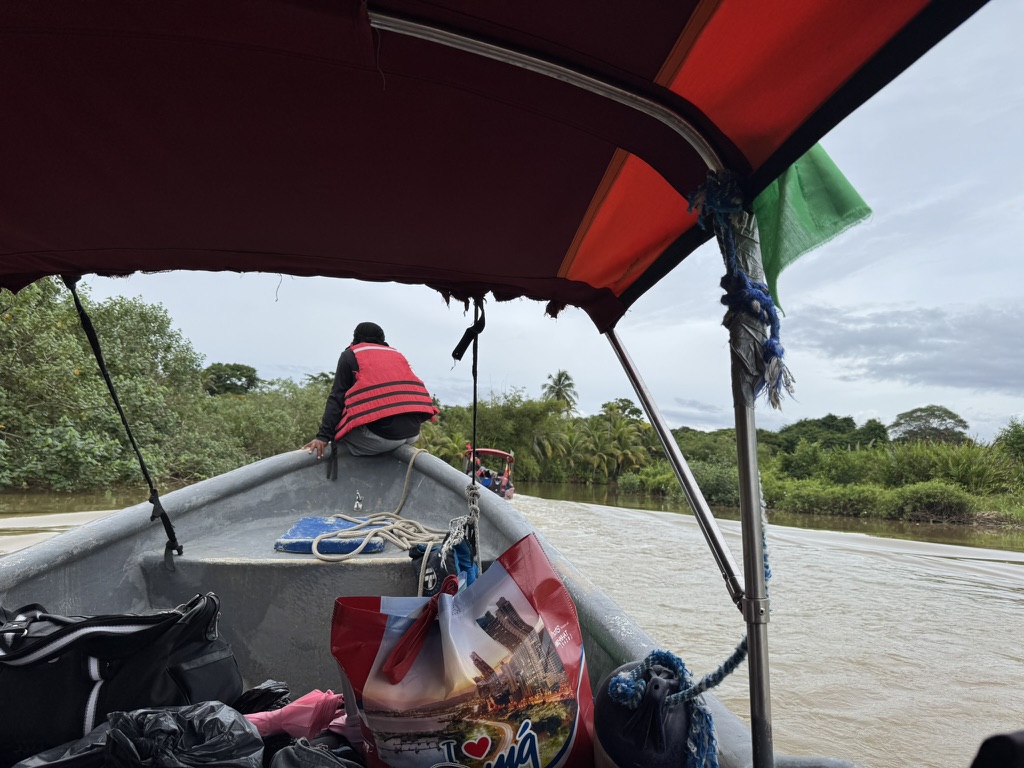
Sinds 1925 heeft de Guna hun eigen semi-autonome provincie, veroverd na een opstand tegen de Panamese politie die hun kleding, taal en gewoonten decennialang had verboden. Drie dagen duurde die opstand. Het resultaat heet Guna Yala: een archipel van 365 eilanden waarvan er negenenveertig bewoond zijn, bestuurd door een eigen congres volgens traditionele wetten. Op de kade van Cartí worden plastic boodschappentassen de boot in gegooid, de wekelijkse bevoorrading vanuit het vasteland. Onze backpacks erachteraan, en instappen maar.
“Toerisme mag hier, maar alleen op hun voorwaarden.”
Geen welkomstdrankje, wel een bed
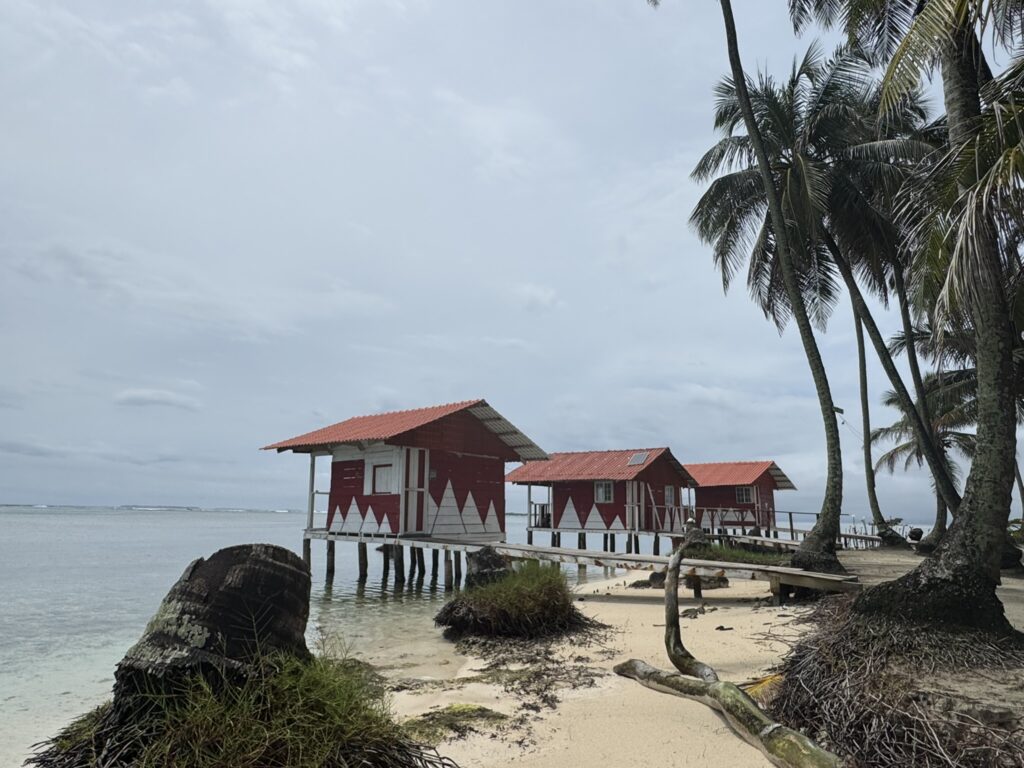
Het eiland waar we aankomen heeft geen toeristische naam. Vijftig meter lang, twintig breed, drie houten hutten op palen en een gastenverblijf met acht kamers. Het toilet spoelen we door met een emmer regenwater. Alles is schoon en strak georganiseerd, maar niemand haast zich om ons dat te vertellen. We worden zwijgend naar onze kamer geleid. Hier is ons bed, de rest zien we zelf wel.
’s Avonds eten we wat er is, rijst, verse vis en banaancakes, gedeeld met de familie die ons onderdak geeft. Alcohol is collectief verboden door de gemeenschap, wifi is er bewust niet. We hangen in onze hangmat en horen Dulegaya, de taal van de Guna die nergens anders op aarde wordt gesproken. Iemand speelt een kaartspel verderop. Er is stilte en ruimte voor die stilte om te blijven hangen.
Waarom er nooit een resort kwam
In de jaren tachtig klopten internationale hotelketens aan met plannen voor resorts en cruiseschepen. De Guna zeiden nee en hun congres stelde regels op die nog steeds gelden: geen buitenlandse eigenaars, grote hotels of vervuiling. Foto’s maken van mensen mag alleen na toestemming. Afval hoort in de daarvoor bestemde bakken. We zijn hier gast en dat voelen we in elk gesprek.
’s Middags varen we naar een zandbank waar het water zo helder is dat we zeesterren op de bodem kunnen zien liggen zonder ook maar een duik te nemen. De volgende dag snorkelen we bij een scheepswrak, kleurige vissen tussen roestige stalen restanten, al voelt ons eigen eiland van gisteren nog altijd intiemer aan dan deze drukkere plek. ’s Nachts barst een tropische storm los en staat het water ’s ochtends tot onze enkels, twee uur later is alles alweer droog en gewoon.
Terug met een ander gewicht
De terugweg naar Cartí duurt een uur. Dezelfde Guna-man staat nog bij de grenscontrole. We zijn weer in Panama, technisch gezien waren we dat altijd al, maar we voelen dat we ergens anders zijn geweest. Een uur later zijn we weer online, berichten en meldingen die zich opstapelen, en dat voelt ook wel weer prettig. Maar we weten nu dat er een plek bestaat waar massatoerisme een bewuste, harde keuze is om niet te laten gebeuren. En waar dat gewoon werkt.
Op het strand van Cartí staat een jongen met een emmer vis op zijn schouder, hij loopt langzaam richting het dorp terwijl de pick-up alweer klaarstaat voor de volgende lading toeristen.
“Entry to Guna Yala,” he says, and we are still in Panama, though technically we are also not. The first border check happens in the back of a pickup truck, miles before we catch our first glimpse of the Caribbean Sea. A Guna man stops the vehicle, studies our passports with the calm of someone who has done this a thousand times, and asks for twenty dollars. We pay without arguing. That is the deal here.
An uprising that lasted three days
Since 1925, the Guna have run their own semi-autonomous province, won after an uprising against the Panamanian police who had banned their clothing, language and customs for decades. The revolt lasted three days. The result is Guna Yala, an archipelago of 365 islands, forty nine of them inhabited, governed by their own congress under traditional law. On the dock at Cartí, plastic grocery bags get tossed into the boat, the weekly supply run from the mainland. Our backpacks go in after them, and then we climb aboard.
“Tourism is allowed here, but only on their terms.”
No welcome drink, but a bed
The island we land on has no tourist name. Fifty meters long, twenty wide, three wooden huts on stilts and a guesthouse with eight rooms. We flush the toilet with a bucket of rainwater. Everything is clean and tightly organized, though nobody rushes to point that out. We are led to our room in silence. Here is our bed, we will figure out the rest.
In the evening we eat whatever there is, rice, fresh fish and banana cakes, shared with the family hosting us. Alcohol is banned by community rule, wifi is deliberately absent. We lie in our hammock and hear Dulegaya, the Guna language spoken nowhere else on earth. Someone plays cards nearby. There is silence, and there is room for that silence to simply stay.
Why no resort ever showed up
In the 1980s, international hotel chains came knocking with plans for resorts and cruise stops. The Guna said no, and their congress drew up rules that still stand today: no foreign ownership, no large hotels, no pollution. Taking photos of people requires permission first. Trash goes in designated bins. We are guests here, not customers, and we feel that in every exchange.
In the afternoon we sail out to a sandbank where the water is so clear we can see starfish on the bottom without diving in. The next day we snorkel near a shipwreck, colorful fish weaving through rusted steel, though our own island from the day before still feels more intimate than this busier spot. At night a tropical storm breaks loose and by morning the water sits at our ankles, two hours later everything is dry and ordinary again.
Back with a different weight
The trip back to Cartí takes an hour. The same Guna man still stands at the checkpoint. We are back in Panama, technically we never left, but we feel like we have been somewhere else entirely. An hour later we are online again, messages and notifications piling up, and that feels good too, in its own way. But now we know a place exists where mass tourism is a deliberate, hard choice not to allow. And where that choice simply works.
On the beach at Cartí, a boy carries a bucket of fish over his shoulder, walking slowly toward the village while the pickup truck idles, ready for the next load of tourists.
San Blas eilanden bezoeken, dit moet je weten
De San Blas eilanden, in het Guna-gebied Guna Yala, zijn een autonoom territorium van 360 eilanden aan de Caraïbische kust van Panama. Vanuit Panama City vertrekken 4×4’s om 5 tot 5:30 uur naar de haven Cartí, drie uur rijden over onverharde bergwegen. Vanaf Cartí gaat een boot in 20 tot 40 minuten naar je eiland. Een dagtour kost 65 tot 159 dollar per persoon, plus 22 dollar entree Guna. Paspoort verplicht bij binnenkomst, het is een autonoom gebied.
Populaire dagtripbestemmingen zijn Isla Perro Chico met de shipwreck om te snorkelen, de Natural Pool (zandbank in ondiep water) en Isla Chichime met palmen. Voor een overnachting boek je een van de eenvoudige cabañas op eilanden als Cangrejo of Aguja. Reken op 100 tot 250 dollar per persoon per nacht inclusief eten. Wifi en elektriciteit zijn beperkt tot generator-uren, breng cash mee want er zijn geen pinautomaten in Guna Yala.
Vaakgestelde vragen over San Blas
Hoe kom je bij San Blas eilanden?
4×4-transfer van Panama City naar Cartí haven, drie uur rijden. Boekingen gaan via tour operators. Vertrek meestal om 5 uur vroeg. Vanaf Cartí met boot 20 tot 40 minuten naar de eilanden.
Wat kost een bezoek aan San Blas?
Dagtour vanaf 65 dollar tot 159 dollar per persoon. Overnachting in cabaña 100 tot 250 dollar per persoon inclusief maaltijden. Plus 22 dollar Guna entrance fee. Betaling meestal alleen cash in dollars.
Kun je op één dag naar San Blas en terug?
Ja, maar je bent zes uur onderweg voor slechts vier tot vijf uur op de eilanden. Een overnachting geeft veel meer rust. Boek dan minstens twee nachten om echt aan te komen.
Is San Blas veilig?
Ja, het gebied wordt bestuurd door de Guna gemeenschap zelf en er is geen criminaliteit gericht op toeristen. Wees voorzichtig met de zon, breng waterschoenen mee voor het zeegras en koraal.
Wat is Guna Yala precies?
Een autonoom gebied van het Guna volk binnen Panama sinds 1925. Ze hebben eigen wetten, geld (dollar) en toeristische regels. Respecteer het verbod op naaktzwemmen en foto’s zonder toestemming.
Wanneer is de beste tijd voor San Blas?
Droog seizoen december tot en met april met stralend weer en rustige zee. Regenseizoen mei tot en met november geeft dagelijkse buien maar meer aanbod en lagere prijzen.
Meer uit Midden-Amerika en het Caribisch gebied
Over Elle
Elle Verbeek is reisjournalist en purser bij KLM. Ze schrijft columns en reisverhalen, deels voor eigen platform, deels voor Nederlandse magazines. Op Ellevie Travels deelt ze reisreportages van de bestemmingen waar ze naartoe vliegt of waar ze zelf naartoe reist.
Visiting the San Blas islands: what to know
The San Blas islands, in the Guna Yala region, are an autonomous territory of 360 islands along Panama’s Caribbean coast. From Panama City, 4x4s leave at 5 to 5:30 a.m. for the Cartí port, a three-hour drive on unpaved mountain roads. From Cartí, a boat takes 20 to 40 minutes to your island. A day tour costs $65 to $159 per person, plus $22 Guna entrance fee. Passport required on arrival; it’s an autonomous region.
Popular day-trip stops include Isla Perro Chico with the shipwreck for snorkeling, the Natural Pool (a sandbank in shallow water), and Isla Chichime with palms. For an overnight, book one of the simple cabañas on islands like Cangrejo or Aguja. Budget $100 to $250 per person per night including meals. Wifi and electricity are limited to generator hours; bring cash because there are no ATMs in Guna Yala.
Frequently asked questions about San Blas
How do you get to the San Blas islands?
4×4 transfer from Panama City to Cartí port, a three-hour drive. Bookings go through tour operators. Departure usually 5 a.m. From Cartí by boat 20 to 40 minutes to the islands.
What does a visit to San Blas cost?
Day tour from $65 to $159 per person. Overnight in a cabaña $100 to $250 per person including meals. Plus $22 Guna entrance fee. Payment usually cash only, in dollars.
Can you do San Blas as a day trip?
Yes, but you’re on the road for six hours for just four to five hours on the islands. An overnight gives much more calm. Book at least two nights to really arrive.
Is San Blas safe?
Yes, the area is run by the Guna community themselves and there’s no crime targeting tourists. Watch out for the sun, bring water shoes for the seagrass and coral.
What exactly is Guna Yala?
An autonomous region of the Guna people within Panama since 1925. They have their own laws, currency (dollar), and tourism rules. Respect the ban on nude swimming and taking photos without permission.
When is the best time for San Blas?
Dry season December through April with sunny weather and calm seas. Rainy season May through November brings daily showers but more availability and lower prices.
More from Central America and the Caribbean
About Elle
Elle Verbeek is a travel journalist and KLM purser. She writes columns and travel stories, partly for her own platform, partly for Dutch magazines. On Ellevie Travels she shares reportage from the destinations she flies to or travels to on her own.
Praktische tips uit dit verhaal Practical tips from this story
-
Hoofdplaats en aankomsthaven El Porvenir — De hoofdplaats van Guna Yala en het startpunt van de meeste tours. Kleine landingsbaan, houten steigers, molas te koop van de Guna-vrouwen: mooie handgeborduurde textielpanelen.
Main town and arrival port El Porvenir — The capital of Guna Yala and starting point for most tours. Small airstrip, wooden jetties, molas for sale from Guna women: hand-embroidered textile panels.
-
Eilanden / bestemming San Blas / Guna Yala — Autonoom gebied van het Guna-volk: kokosbomen, kilometers wit strand, molas en langoest. Ga via een door de Guna erkende tour vanuit Panama-Stad.
Islands / destination San Blas / Guna Yala — The Guna people's autonomous region: coconut palms, miles of white beach, molas and lobster. Go via a Guna-authorised operator from Panama City.
-
Onbewoond eilandje Isla Perro Chico — Klein zandeilandje met een gezonken scheepswrak in het ondiepe water, ideaal om te snorkelen. Meestal onderdeel van een bootexcursie, zorg dat je masker en snorkel meeneemt.
Uninhabited island Isla Perro Chico — A small sand island with a sunken shipwreck in shallow water, perfect for snorkeling. Usually part of a boat tour, bring your own mask and snorkel if you can.