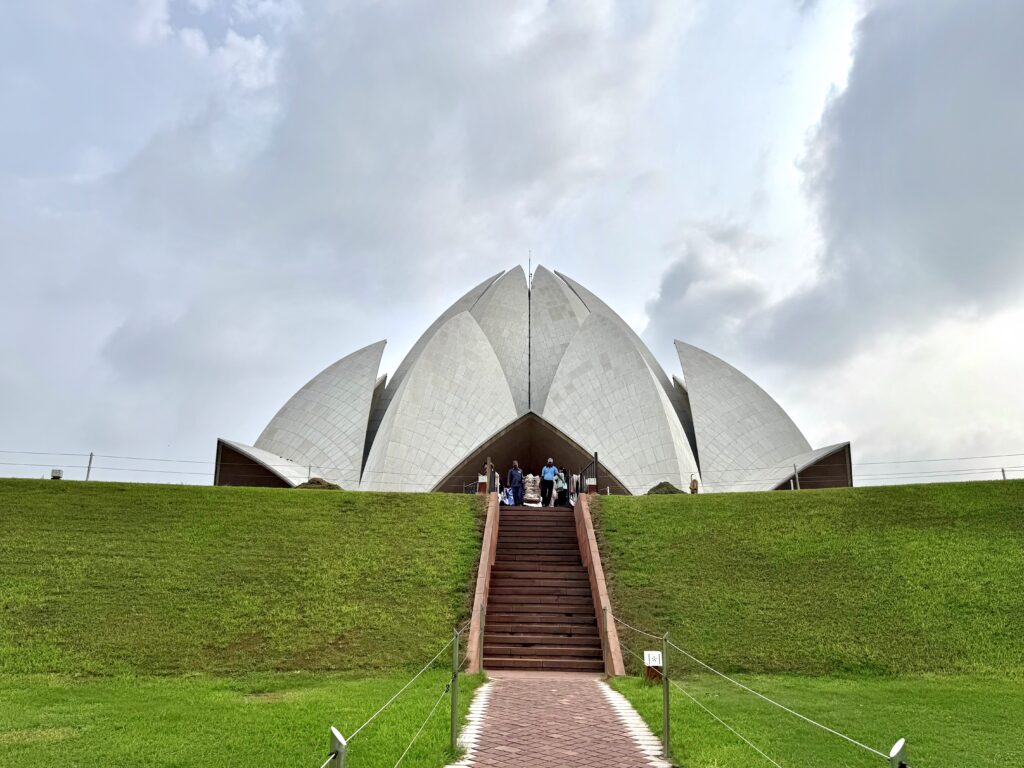
Een tuk-tuk toetert twee keer achter elkaar, marktkramers zwaaien zakjes chai naar onze hoofden, specerijen en uitlaatgassen vermengen zich tot iets dat we alleen in Delhi ruiken. En dan staan we ineens voor negen marmeren bloemblaadjes die samen een lotus vormen, roerloos wit tegen een grijsblauwe lucht, en valt het lawaai weg als een deur die achter ons dichtklapt.
“Twee tempels, jong van jaren, die miljoenen mensen weten te vinden.”
Stilte in wit marmer
De Lotus Temple werd in 1986 geopend als huis van aanbidding voor het Baháʼí-geloof, een religie die uitgaat van één God en alle andere religies ziet als takken van dezelfde boom. De Iraanse architect Fariborz Sahba ontwierp negen gigantische marmeren bloemblaadjes die samen de vorm van een lotus vormen, het Indiase symbool voor zuiverheid. Tuinen en vijvers cirkelen eromheen als een tweede stilte om de eerste heen.
Binnen zitten bezoekers naast elkaar op houten banken. Sommigen bidden, anderen mediteren, weer anderen zijn hier simpelweg om twintig minuten niets te moeten. Zonlicht valt schuin door de openingen in het gewelf naar binnen. Niemand fluistert, want niemand hoeft te fluisteren. De ruimte doet het werk.
Hindoetraditie zonder rem
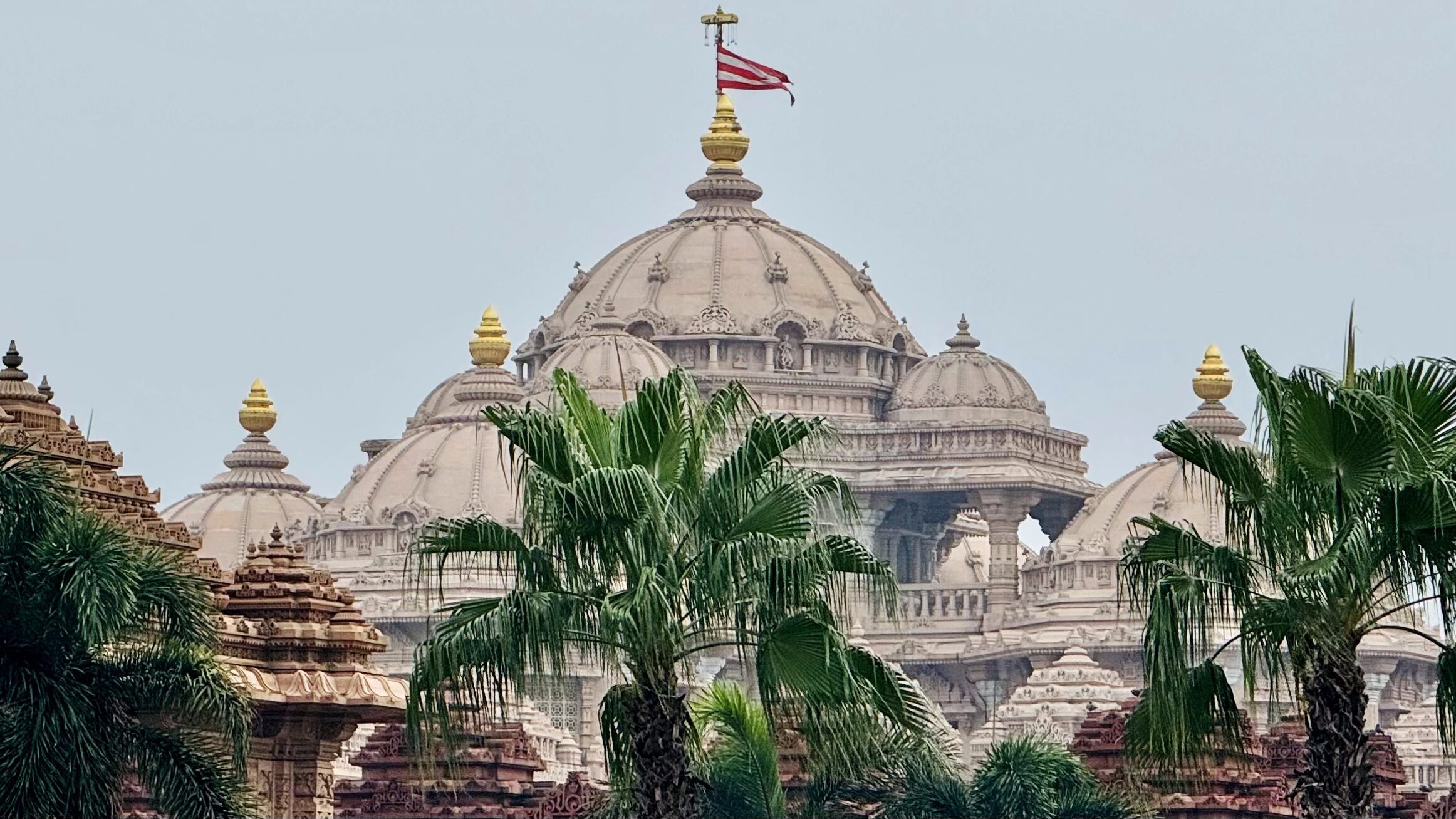
Een uur verderop barst Akshardham uit zijn voegen. Sinds 2005 staat dit complex van meer dan honderd hectare aan de rand van de stad, gebouwd door duizenden ambachtslieden die jarenlang met traditionele beitels in steen hakten. De hoofdtempel is opgetrokken uit roze zandsteen en wit marmer en er is geen centimeter onbewerkt gelaten. Zuilen, bogen en gevels vertellen stuk voor stuk een fragment uit de hindoemythologie. Bij de Gajendra Pith staan honderdveertig olifanten in steen gehouwen, zo levendig.
Het ruikt hier naar wierook. Er klinkt gezang, er liggen bloemenslingers bij de beelden, er schuifelen bedevaartgangers tussen toeristen met camera’s. Zodra de avond valt, spuiten fonteinen water de lucht in en dansen lichtstralen over het complex terwijl muziek aanswelt. Voor de meeste bezoekers is het een schouwspel. Voor veel Indiërs is het iets anders: een gebedsmoment verpakt in theater.
Twee uitersten, één dag
De Lotus Temple fluistert, Akshardham buldert. Het een is minimalisme, het ander overdaad. Toch draait het op beide plekken uiteindelijk om hetzelfde: een moment waarop we even iets groters voelen dan onszelf. Wie een dag heeft, begint vroeg bij de Lotus Temple, wanneer het marmer nog koel is en de rijen kort zijn, en rijdt daarna naar Akshardham voor de middag en de avondshow. Zo proeven we in twaalf uur zowel de rust als het spektakel, en zien we hoe deze stad tegenstellingen niet oplost, maar naast elkaar laat bestaan.
Bij het verlaten van de Lotus Temple schuiven we onze slippers weer aan onze voeten. Buiten wacht het geluid van claxons, alsof de stad ons er meteen weer bij wil hebben.
A tuk-tuk honks twice in a row, market vendors wave bags of chai at our heads, spices and exhaust fumes blend into something we only smell in Delhi. And then we find ourselves standing in front of nine marble petals forming a lotus, motionless white against a gray-blue sky, and the noise drops away like a door slamming shut behind us.
“Two temples, young in age, that still draw millions of visitors.”
Silence in white marble
The Lotus Temple opened in 1986 as a house of worship for the Baháʼí faith, a religion built on the idea of one God and every other religion as a branch of the same tree. Iranian architect Fariborz Sahba designed nine massive marble petals that together form a lotus, India’s symbol of purity. Gardens and ponds circle around it like a second silence wrapped around the first.
Inside, visitors sit side by side on wooden benches. Some pray, some meditate, others are simply here to need nothing for twenty minutes. Sunlight slants through the openings in the dome. Nobody whispers, because nobody has to. The room does the work.
Hindu tradition without a filter
An hour away, Akshardham bursts at the seams. Since 2005, this complex of more than a hundred hectares has stood at the edge of the city, built by thousands of artisans who spent years carving stone with traditional chisels. The main temple rises in pink sandstone and white marble, and there is not one untouched inch. Pillars, arches and facades each tell a fragment of Hindu mythology. At the Gajendra Pith, a hundred and forty elephants stand carved in stone, so lifelike.
Incense hangs in the air here. Chanting rises, garlands lie at the feet of statues, pilgrims shuffle between tourists with cameras. Once evening falls, fountains shoot water into the sky and light beams sweep across the complex as music swells. For most visitors, it reads as spectacle. For many Indians, it is something else: a prayer wrapped in theater.
Two extremes, one day
The Lotus Temple whispers, Akshardham roars. One is minimalism, the other excess. Yet both places ultimately circle the same thing: a moment where we feel something larger than ourselves. With a full day, we start early at the Lotus Temple, while the marble is still cool and the lines are short, then head to Akshardham for the afternoon and the evening show. In twelve hours we get both the calm and the spectacle, and we see how this city does not resolve its contradictions, it simply lets them stand side by side.
Leaving the Lotus Temple, we slide our sandals back on. Outside, the sound of car horns waits, as if the city wants us back immediately.
Lotus Temple en Akshardham bezoeken, dit moet je weten
De Lotus Temple staat aan Lotus Temple Road in Bahapur, Kalkaji (postcode 110019). Open in de zomer (april tot en met september) van 9.00 tot 19.00 uur, in de winter (oktober tot en met maart) van 9.00 tot 17.30 uur. Elke maandag gesloten voor onderhoud. Toegang is volledig gratis voor iedere religie en nationaliteit. Metro: Kalkaji Mandir (Violet en Magenta Line), vijf minuten lopen. Schoenen uit voor de gebedszaal, stilte binnen, fotograferen mag alleen buiten. Ontworpen door de Iraanse architect Fariborz Sahba, geopend in 1986.
Akshardham ligt aan NH 24, Pramukh Swami Maharaj Marg in Pandav Nagar (postcode 110092). Open van dinsdag tot en met zondag van 9.30 tot 18.30 uur, laatste toegang om 18.30, maandag gesloten. Complex en Mandir Darshan zijn gratis. De tentoonstellingen kosten 260 roepie voor volwassenen, 210 voor senioren en 160 voor kinderen (4 tot 11 jaar). De Sahaj Anand Water Show na zonsondergang (rond 19.15 uur) kost 110 roepie voor volwassenen en 80 voor kinderen. Metro: Akshardham station op de Blue Line, zeven minuten lopen. Mobiele telefoons en camera’s mogen niet mee naar binnen; een gratis kluis staat klaar bij de ingang. Online reservering niet mogelijk, dus kom vroeg.
Vaakgestelde vragen over Lotus Temple en Akshardham
Kost een bezoek aan Lotus Temple geld?
Nee. Toegang tot de Lotus Temple is volledig gratis, voor elke religie en nationaliteit. Ook geen toeslag voor buitenlanders.
Wanneer is Akshardham gesloten?
Elke maandag. De rest van de week open van 9.30 tot 18.30 uur, laatste toegang op 18.30. Het Mandir Darshan is gratis, tentoonstellingen kosten wel entree.
Welke tempel past bij mij?
Lotus Temple voor stilte, meditatie en minimalistische architectuur van wit marmer. Akshardham voor uitbundige hindoetraditie, ambacht in roze zandsteen en een waterspektakel na zonsondergang.
Hoe kom ik er met de metro?
Lotus Temple: station Kalkaji Mandir (Violet of Magenta Line), vijf minuten lopen. Akshardham: gelijknamig station op de Blue Line, zeven minuten lopen. Beide goed bereikbaar zonder tuk-tuk.
Wat mag ik niet meenemen naar Akshardham?
Mobiele telefoons, camera’s, laptops en pennen zijn niet toegestaan in het complex. Bij de ingang is een gratis kluis. Wel welkom: kleine tassen, water en identificatie.
Kunnen we beide tempels op één dag doen?
Ja. Beide met de metro bereikbaar, ongeveer 45 minuten reistijd van elkaar. Begin bij Akshardham (dat langer duurt, twee tot vier uur), sluit af met de Lotus Temple net voor sluitingstijd voor het stille contrast.
Over Elle
Elle Verbeek is reisjournalist en purser bij KLM. Ze schrijft columns en reisverhalen, deels voor eigen platform, deels voor Nederlandse magazines. Op Ellevie Travels deelt ze reisreportages van de bestemmingen waar ze naartoe vliegt of waar ze zelf naartoe reist.
Meer uit Delhi
Visiting Lotus Temple and Akshardham: what to know
The Lotus Temple is on Lotus Temple Road in Bahapur, Kalkaji (110019). Open in summer (April through September) from 9:00 AM to 7:00 PM, in winter (October through March) from 9:00 AM to 5:30 PM. Closed every Monday for maintenance. Admission is completely free for every religion and nationality. Metro: Kalkaji Mandir (Violet and Magenta Line), a five-minute walk. Shoes off before the prayer hall, silence inside, photography allowed outside only. Designed by Iranian architect Fariborz Sahba and opened in 1986.
Akshardham sits at NH 24, Pramukh Swami Maharaj Marg in Pandav Nagar (110092). Open Tuesday through Sunday from 9:30 AM to 6:30 PM, last entry at 6:30 PM, closed Mondays. The complex and Mandir Darshan are free. Exhibitions cost 260 rupees for adults, 210 for seniors, and 160 for children (4 to 11). The Sahaj Anand Water Show after sunset (around 7:15 PM) costs 110 rupees for adults and 80 for children. Metro: Akshardham station on the Blue Line, a seven-minute walk. Mobile phones and cameras are not allowed inside; a free locker is available at the entrance. Online booking is not available, so arrive early.
Frequently asked questions about Lotus Temple and Akshardham
Does visiting the Lotus Temple cost anything?
No. Admission to the Lotus Temple is completely free, for every religion and nationality. No foreigner surcharge.
When is Akshardham closed?
Every Monday. The rest of the week open from 9:30 AM to 6:30 PM, last entry at 6:30 PM. The Mandir Darshan is free; exhibitions require a ticket.
Which temple suits me?
Lotus Temple for silence, meditation, and minimalist white marble architecture. Akshardham for exuberant Hindu tradition, craftsmanship in pink sandstone, and an after-sunset water show.
How do I get there by metro?
Lotus Temple: Kalkaji Mandir station (Violet or Magenta Line), five-minute walk. Akshardham: the same-named station on the Blue Line, seven-minute walk. Both easily reached without a tuk-tuk.
What can I not bring into Akshardham?
Mobile phones, cameras, laptops, and pens are not allowed inside the complex. There is a free locker at the entrance. Welcome: small bags, water, and ID.
Can we do both temples in one day?
Yes. Both are accessible by metro, about 45 minutes apart. Start with Akshardham (which takes longer, two to four hours) and end at the Lotus Temple just before closing for a quiet contrast.
About Elle
Elle Verbeek is a travel journalist and KLM purser. She writes columns and travel stories, partly for her own platform, partly for Dutch magazines. On Ellevie Travels she shares reportage from the destinations she flies to or travels to on her own.
More from Delhi
Praktische tips uit dit verhaal Practical tips from this story
-
Street art / kunstwijk Lodhi Art District — Ambtenarenkolonie omgetoverd tot enorme openluchtgalerij. Tientallen muurschilderingen van internationale kunstenaars, ideaal voor een rustige middagwandeling. st-artindia.org · @startindia · meer info
Street art / arts district Lodhi Art District — A civil-servant colony reborn as an open-air gallery. Dozens of murals by international artists — perfect for a quiet afternoon stroll. st-artindia.org · @startindia · more info
-
Historisch mausoleum + tuin Safdarjung Tomb — Klein Taj Mahal-gevoel: symmetrische Mogol-tuinen, roze zandsteen, tegen zonsopgang zacht geel. Zonder de rijen bij Humayun's Tomb. asi.nic.in
Historic mausoleum + garden Safdarjung Tomb — A Taj Mahal in miniature: symmetrical Mughal gardens, pink sandstone glowing gold at sunrise. Without the Humayun's Tomb queues. asi.nic.in
-
Ambachtenmarkt · streetfood · Zuid-Delhi Dilli Haat INA — geregisseerde chaos vol regionale kunst en keukens — Openluchtmarkt waar verkopers uit heel India elke twee weken rouleren. Stoffen, sieraden en regionale keukens onder gekleurde doeken, geordend en toch levendig. delhitourism.gov.in · meer info
Crafts market · street food · South Delhi Dilli Haat INA — curated chaos of regional crafts and kitchens — Open-air market where vendors from across India rotate every two weeks. Textiles, jewellery and regional kitchens under colourful canopies, organised yet lively. delhitourism.gov.in · more info
-
Ambachten- en foodmarkt Dilli Haat INA — Openluchtmarkt met kunstnijverheid, textiel en foodstalls uit alle Indiase staten. Handig voor cadeaus zonder in een tuk-tuk hele wijken af te struinen.
Crafts and food market Dilli Haat INA — Open-air market with crafts, textiles and food stalls from every Indian state. Great for gifts without trailing across the city by tuk-tuk.
-
Historisch monument · tuin · Zuid-Delhi Safdarjung Tomb — een kleine Taj Mahal midden in de drukte — Achttiende-eeuws Mughal-mausoleum in een strak gemaaide tuin, waar de stad even op mute lijkt te staan. Palmbomen, picknickende families, een tombe die aan een kleine Taj Mahal doet denken. delhitourism.gov.in · meer info
Historic monument · garden · South Delhi Safdarjung Tomb — a little Taj Mahal in the heart of the city — Eighteenth-century Mughal mausoleum set in a manicured garden where the city seems to hit mute. Palm trees, picnicking families and a tomb that echoes a smaller Taj Mahal. delhitourism.gov.in · more info
-
Street art · openluchtgalerij · Lodi Colony Lodhi Art District — straatkunst in stille woonstraten — India's eerste openluchtkunstwijk met muurschilderingen van meer dan zeventig Indiase en internationale kunstenaars. Loop rustig door de smalle straatjes en respecteer dat er mensen wonen. timeout.com · meer info
Street art · open-air gallery · Lodi Colony Lodhi Art District — street art in quiet residential streets — India's first open-air public art district with murals by more than seventy Indian and international artists. Walk slowly through the narrow streets and remember it's a residential neighbourhood. timeout.com · more info