
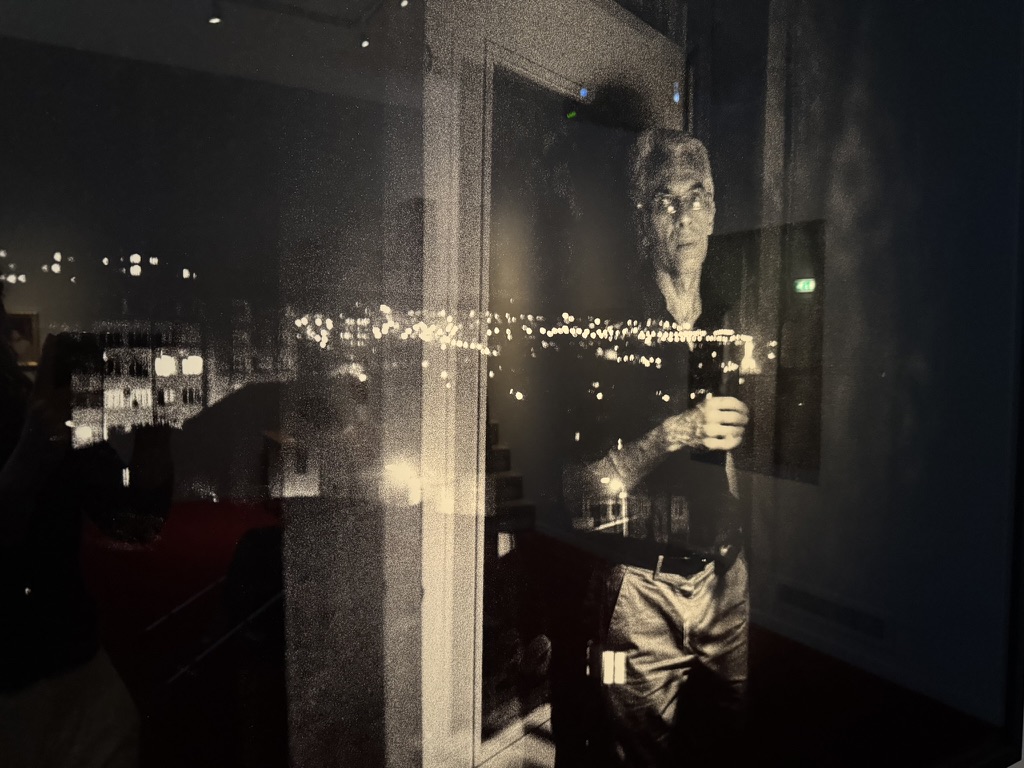
Een rood tapijt. Een handgeschreven brief aan een ambassade, in vitrine. Pianomuziek die ergens vaag aan Comptine d’un autre été uit Amélie doet denken. Zo begin je, in FOAM, en zo trekt het je binnen: aan de muur een zwart-witportret van een vrouw met een bellenblaas, twee bellen zwevend onder grijze wolken, en in de vitrine ernaast een brief van een vader die zijn kinderen kwijtraakt tijdens de val van de Sovjet-Unie en hen jarenlang probeert te vinden via willekeurige adressen in Amerika. Een kleine tekst op de muur, in cursief handschrift: “Ik word wakker en ren de straat op in paniek.”
Vijftien jaar later vinden ze elkaar terug. En dan blijft de vraag: wat vangt een camera daar nog van? Van dat weerzien, van al die jaren ertussen? Beeld na beeld snijdt de tentoonstelling open wat achterblijft: rouw, tijd en die ene ontwrichtende vraag, wie ben jij nu geworden.
IJzeren trappen omhoog
Een smalle ijzeren trap brengt je naar de volgende verdieping, en meteen kantelt de tijd. Persoonlijke brieven maken plaats voor collectieve herinnering: 1944, zwart-wit, grauw, rauw. Bezetting, vervolging, verzet, honger. Foto’s van kreten op muren, uitgeputte mensen op een stoep, ingevallen wangen boven een kopje thee met een kruimel koek. Een hand die een gele ster opnaait. De schaduw van de fotograaf zelf op het trottoir, getuige in beeld.
Etalages met gebroken ramen. Tramrails uit elkaar gehaald voor hout. En dan, aan het eind van de zaal, kantelt de toon: laagvliegende bommenwerpers die eten droppen, dansende soldaten, jonge vrouwen die lachend achterom kijken. Bevrijding. Toch blijft de leegte hangen. In de gezichten van mensen op straat, in wat níét is vastgelegd, in de stiltes tussen de foto’s.
“Fotografie als macht, maar ook als middel om vergeten verhalen terug te halen.”
Curiel en het verhaal dat niet werd verteld
Verderop kantelt het decor opnieuw: Suriname, begin twintigste eeuw. Portretten door Augusta Curiel, een vrouwelijke fotograaf die samen met haar zus en broer een studio runde in Paramaribo. Op haar foto’s staan welgestelde families in nette witte kleding, trots poserend, precies zoals ze zich wilden laten zien in een gebied dat toen deel uitmaakte van het Koninkrijk. Maar Curiel legde ook anonieme figuren vast, van wie je niet weet wie ze zijn, of wat hun rol was. En juist in die stiltes voel je wat níét verteld wordt: de hiërarchie, de ongelijkheid, de afwezigheid van andere stemmen.
Wat blijft hangen
Niet één foto, niet één verhaal. Het totaal. Een dochter die haar vader terugvindt. Een stad in oorlog. Een land dat zichzelf moet terugzien in oude beelden. In FOAM krijgt iedereen een plek, soms klein en fluisterend, soms hard en confronterend, maar altijd op ooghoogte.
Buiten kruipt het licht schuin over de gracht. Op de bank aan de overkant zit een man met zijn hond, hij wappert met zijn hand naar een voorbijganger. Je loopt langzaam naar de tram, de zwarte museumtas met witte letters om je schouder, en merkt dat één foto, die met de bellen onder de grijze lucht, nog even blijft hangen.
A red carpet. A handwritten letter to an embassy, in a display case. Piano music that faintly recalls Comptine d’un autre été from Amélie. This is how it starts at FOAM, and this is how it pulls you in: on the wall, a black-and-white portrait of a woman with a bubble wand, two bubbles hovering beneath gray clouds, and beside it, in the vitrine, a letter from a father who lost his children during the collapse of the Soviet Union and spent years trying to find them through random addresses across America. A small line of cursive script on the wall: “I wake up and run into the street in a panic.”
Fifteen years later, they find each other again. And then the question lingers: what can a camera still catch of that? Of the reunion itself, of all those years in between? Frame by frame, the exhibition opens up what remains: grief, time and that one destabilizing question: who have you become in the meantime?
Iron stairs up
A narrow iron staircase leads you to the next floor, and time immediately shifts. Private letters give way to collective memory: 1944, black and white, gray, raw. Occupation, persecution, resistance, hunger. Photographs of slogans scratched onto walls, exhausted people slumped on a stoop, sunken cheeks above a cup of tea and a crumb of biscuit. A hand sewing on a yellow star. The photographer’s own shadow across the sidewalk, a witness in the frame.
Shop windows with shattered glass. Streetcar rails pried up for firewood. And then, at the end of the room, the tone turns: low-flying bombers dropping food, dancing soldiers, young women glancing back over their shoulders, laughing. Liberation. And yet the emptiness lingers. In the faces of people on the street, in what was never captured, in the silences between the photographs.
“Photography as power, but also as a way of retrieving stories that were nearly forgotten.”
Curiel and the story that was never told
Further on, the setting shifts once more: Suriname, early twentieth century. Portraits made by Augusta Curiel, a woman photographer who ran a studio in Paramaribo together with her sister and brother. Her photographs show well-off families posing in crisp white, proudly, exactly as they wished to be seen in a territory then part of the Dutch Kingdom. But Curiel also photographed anonymous figures whose names and roles are lost to us. And it is in those silences that you feel what was never said: the hierarchy, the inequality, the absent voices.
What lingers
Not a single photograph, not one story. The whole. A daughter who finds her father again. A city at war. A country asked to see itself in old images. At FOAM, everyone gets a place, sometimes small and whispered, sometimes hard and confronting, but always at eye level.
Outside, the light slants low across the canal. On the bench opposite the museum a man sits with his dog, waving casually at a passerby. You walk slowly toward the tram, the black museum tote with its white letters slung over your shoulder, and realize that one photograph, the one with the bubbles under the gray sky, is still with you.
Foam Amsterdam bezoeken, dit moet je weten
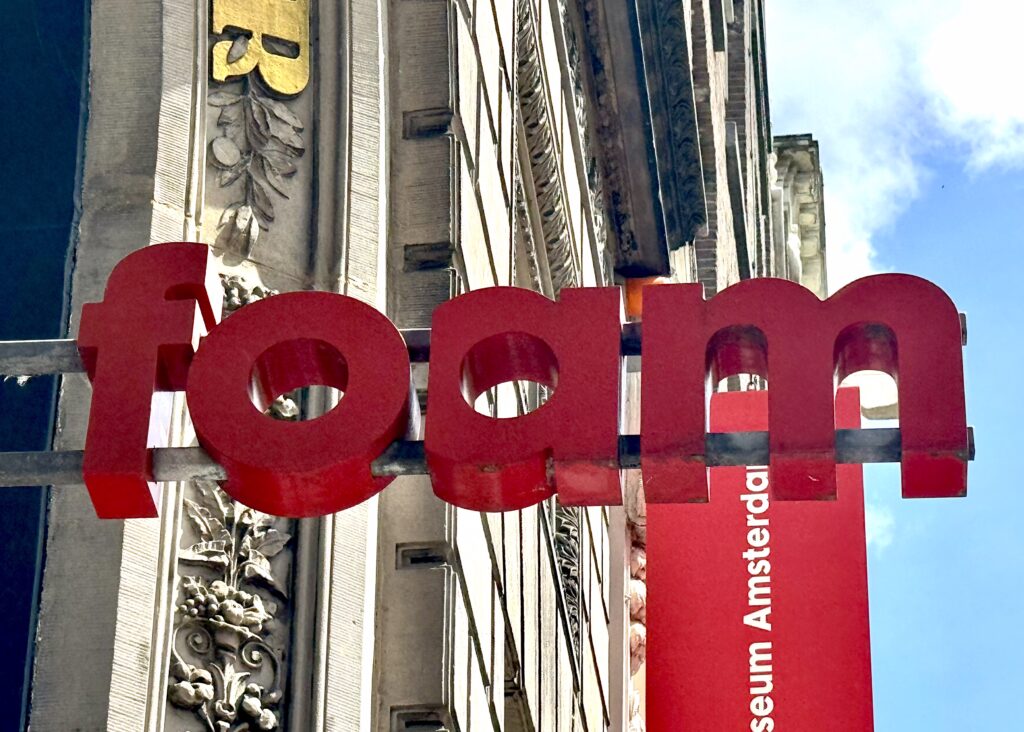
Foam ligt aan de Keizersgracht 609 in het centrum van Amsterdam en is sinds 2001 het internationale fotografiemuseum van de stad. Foam presenteert per jaar zo’n twintig tentoonstellingen, verdeeld over vier verdiepingen van een gerestaureerd grachtenpand. Van gevestigde meesters tot jong talent, van documentaire tot conceptuele fotografie. Vanaf Amsterdam Centraal ben je er in tien minuten met tram 24 tot halte Keizersgracht.
Het museum is dagelijks geopend van tien uur ’s ochtends tot zes uur ’s avonds, op donderdag en vrijdag tot negen uur. Gesloten op Koningsdag. Reguliere toegang kost zestien euro voor volwassenen, studenten twaalf euro tachtig, jongeren van dertien tot achttien elf euro vijfenzeventig, kinderen tot twaalf jaar gratis. Museumkaart geldig, I amsterdam City Card geeft gratis toegang na tijdslotreservering.
Foam draait tegelijkertijd meestal drie tot vier tentoonstellingen. Reken op anderhalf tot twee uur voor een volledig bezoek. Op donderdag- en vrijdagavond is het rustiger dan overdag. In het museum staat alleen een pinbetaalapparaat, contant betalen is niet mogelijk.
Vaakgestelde vragen over Foam Amsterdam
Hoe kom ik bij Foam?
Vanaf Amsterdam Centraal neem je tram 24 richting Zuid tot halte Keizersgracht. Van daar is het één minuut lopen. Fietsers stallen langs de gracht. Autoparkeren is beperkt in dit gebied, gebruik een parkeergarage of park-and-ride.
Wat kost een ticket voor Foam?
Reguliere toegang is zestien euro voor volwassenen. Studenten twaalf euro tachtig, jongeren van dertien tot achttien elf euro vijfenzeventig, kinderen tot twaalf gratis. Museumkaart geldig. I amsterdam City Card gratis met tijdslotreservering. In het museum kun je alleen met pin betalen.
Welke tentoonstellingen lopen er nu?
Foam wisselt de tentoonstellingen elke drie tot vier maanden. Op elk moment lopen er drie tot vier programma’s tegelijkertijd, verdeeld over vier verdiepingen. Actuele programmering staat op de website van Foam.
Hoe lang duurt een bezoek?
Reken op anderhalf tot twee uur voor een volledige rondgang langs alle vier de verdiepingen. Op donderdag- en vrijdagavond is het aanzienlijk rustiger. Voor een verdiepend bezoek met catalogus in de hand kun je twee tot drie uur inplannen.
Zijn er rondleidingen bij Foam?
Ja, Foam organiseert regelmatig rondleidingen door curatoren en soms door de fotografen zelf. Deze staan aangekondigd in de agenda van de website. Groepsrondleidingen zijn op aanvraag, mail info@foam.org voor tarieven en beschikbaarheid.
Is Foam rolstoeltoegankelijk?
Het monumentale grachtenpand van Foam is helaas niet volledig rolstoeltoegankelijk. Er is een trap bij de ingang en verschillende niveaus binnen het museum. Voor toegankelijkheidsvragen mail info@foam.org.
Over Elle
Elle Verbeek is reisjournalist en purser bij KLM. Ze schrijft columns en reisverhalen, deels voor eigen platform, deels voor Nederlandse magazines. Op Ellevie Travels deelt ze reisreportages van de bestemmingen waar ze naartoe vliegt of waar ze zelf naartoe reist.
Meer uit Amsterdam
Visiting Foam Amsterdam, what you need to know
Foam is at Keizersgracht 609 in the center of Amsterdam and has been the city’s international photography museum since 2001. Foam presents about twenty exhibitions a year, spread across four floors of a restored canal house. From established masters to young talent, from documentary to conceptual photography. From Amsterdam Central Station it’s ten minutes by tram 24 to stop Keizersgracht.
The museum is open daily from ten in the morning to six in the evening, Thursday and Friday until nine. Closed on King’s Day. Regular admission is sixteen euros for adults, students twelve eighty, thirteen to eighteen-year-olds eleven seventy-five, children under twelve enter free. Museumkaart valid; I amsterdam City Card gives free access after time-slot reservation.
Foam typically runs three to four exhibitions simultaneously. Plan for ninety minutes to two hours for a full visit. Thursday and Friday evenings are quieter than daytime. The museum accepts card payments only, no cash.
Frequently asked questions about Foam Amsterdam
How do I get to Foam?
From Amsterdam Central Station, take tram 24 towards the south to stop Keizersgracht. From there it’s a one-minute walk. Cyclists park along the canal. Car parking is limited in this area, use a garage or park-and-ride.
What does a ticket cost?
Regular admission is sixteen euros for adults. Students twelve eighty, thirteen to eighteen-year-olds eleven seventy-five, children under twelve free. Museumkaart valid. I amsterdam City Card free with time-slot reservation. Card payment only.
Which exhibitions are on right now?
Foam rotates exhibitions every three to four months. At any given time three to four programs run in parallel, spread across four floors. Current programming is listed on the Foam website.
How long does a visit take?
Plan for ninety minutes to two hours for a full tour of all four floors. Thursday and Friday evenings are significantly quieter. For a deep visit with catalog in hand, plan two to three hours.
Are there guided tours at Foam?
Yes, Foam regularly organizes tours by curators and occasionally by the photographers themselves. These are announced in the website’s agenda. Group tours are available on request; email info@foam.org for rates and availability.
Is Foam wheelchair-accessible?
The monumental canal house is unfortunately not fully wheelchair-accessible. There is a step at the entrance and various level differences inside. For accessibility questions, email info@foam.org.
About Elle
Elle Verbeek is a travel journalist and KLM purser. She writes columns and travel stories, partly for her own platform, partly for Dutch magazines. On Ellevie Travels she shares reportage from the destinations she flies to or travels to on her own.
More from Amsterdam
Praktische tips uit dit verhaal Practical tips from this story
-
Park en historische locatie Park Frankendael — De Kas ligt in dit stadspark met achttiende-eeuws buitenhuis. Voor of na het diner even door de tuinen wandelen maakt het bezoek compleet, ontspannen, met veel groen. amsterdam.nl
Park and historic site Park Frankendael — De Kas sits inside this city park with an eighteenth-century country house. A stroll through the gardens before or after dinner completes the visit, calm and green. amsterdam.nl
-
Café en terras Westergasterras — Op hetzelfde Westergas-terrein waar de Fabrique zit, ligt dit café met groot terras aan het water. Ideaal voor een koffie of wijn tussen de tentoonstelling en de trein terug. westergasterras.nl
Café and terrace Westergasterras — On the same Westergas grounds as the Fabrique sits this café with a large waterside terrace. Ideal for a coffee or wine between the show and the train home. westergasterras.nl
-
Museum Stedelijk Museum Amsterdam — Grootste museum voor moderne en hedendaagse kunst en design in Nederland — rustiger dan zijn buren aan het Museumplein, met ruimte om echt te kijken. stedelijk.nl · meer info
Museum Stedelijk Museum Amsterdam — The largest museum of modern and contemporary art and design in the Netherlands — quieter than its neighbours on Museumplein, with the space to really look. stedelijk.nl · more info
-
Restaurant · fine dining · Amsterdam-Oost Restaurant de Kas — fine dining in een oude stadskwekerij — In de ochtend geoogst, in de middag op je bord. Groenten uit eigen kas spelen de hoofdrol in een lunch of diner zonder poespas, in een glazen kweekkas uit 1926.
Restaurant · fine dining · Amsterdam-Oost Restaurant de Kas — fine dining in a former city greenhouse — Harvested in the morning, on your plate by afternoon. Vegetables from the restaurant's own greenhouse take centre stage in a fuss-free lunch or dinner, inside a glass greenhouse from 1926.
-
Bioscoop · arthouse · Amsterdam LAB111 — film in een oud pathologisch laboratorium — Roze, lavendelblauw en pastelgroen in een voormalig pathologisch anatomisch laboratorium. Focus op artistieke, experimentele en genrefilms, met zuurdesempizza's uit de steenoven erbij. lab111.nl · meer info
Cinema · arthouse · Amsterdam LAB111 — cinema in a former pathology lab — Pink, lavender-blue and pastel green in a former pathology lab. Focus on artistic, experimental and genre films, with sourdough pizzas from the wood oven on the side. lab111.nl · more info
-
Restaurant IJver — In het pontgebouw van de NDSM-werf zit dit ruime restaurant met terras aan het IJ. Zonovergoten in de zomer, kachels op het terras in de winter, altijd goede vis. ijveramsterdam.nl
Restaurant IJver — Inside the NDSM ferry building sits this spacious restaurant with an IJ-facing terrace. Sun-soaked in summer, heaters on the terrace in winter, always good fish. ijveramsterdam.nl