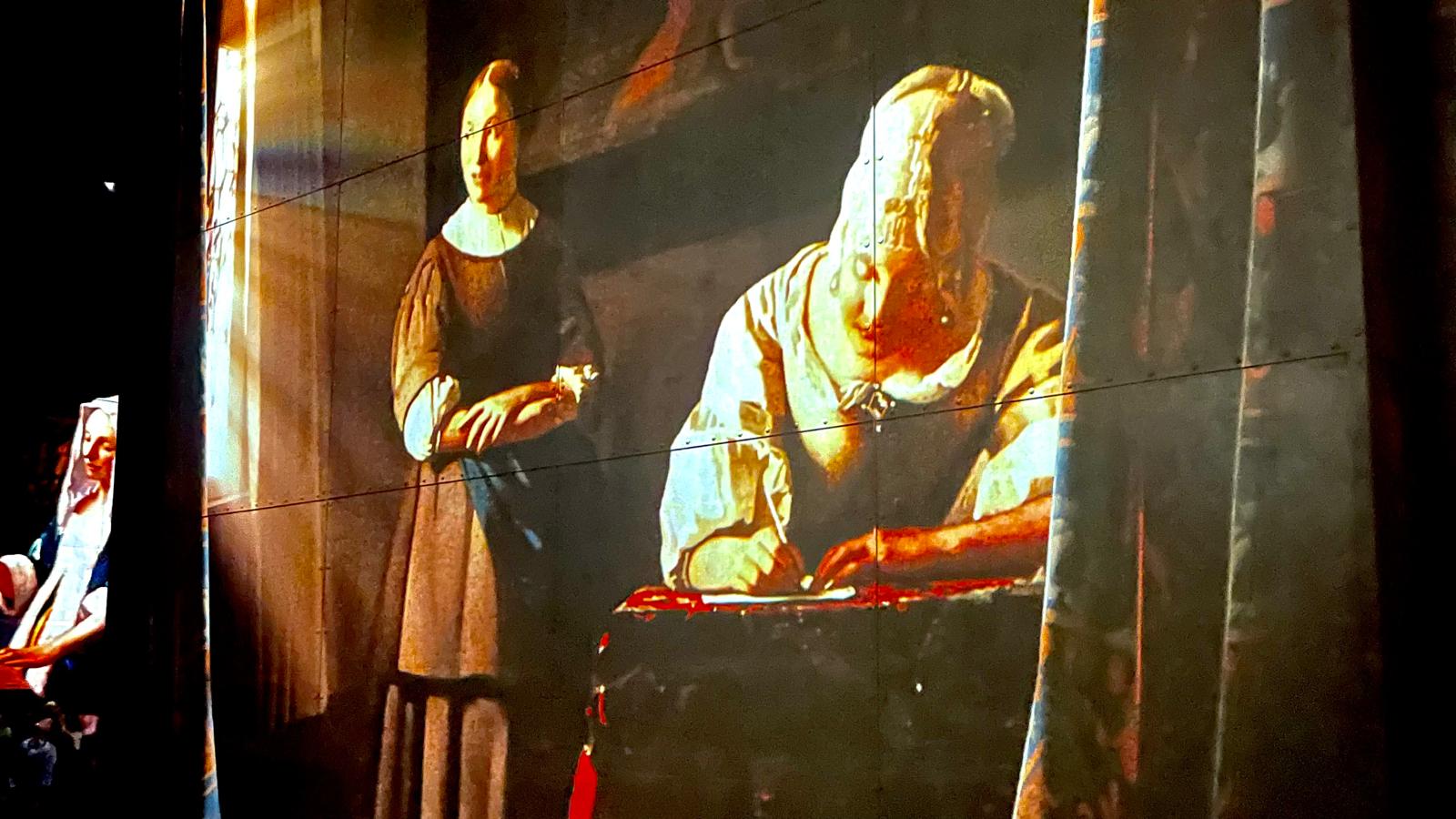
Muziek en geluidseffecten vullen de ruimte al voordat we goed en wel binnen zijn, van het klassieke “Ah mio cor” van Handel tot elektronische beats van Michiru Aoyama en westcoastjazz van Brubeck. Lichten, kleuren en bloempatronen flitsen over de muren van deze voormalige fabriekshal in de Westergas, gietvloer onder onze voeten, houten spoelen als zitplaats, ventilatieroosters nog zichtbaar in het plafond. Een emotionele reactie op oude meesters hangt hier niet meer af van kennis of interpretatie; beeld, geluid en ruimte samen roepen verwondering op, en soms iets wat dichter bij romantiek ligt.
Delft in de Gouden Eeuw
Het begint met een Londens symfonieorkest en de donkere stem van Nitin Sawhney, terwijl de straten van Delft zich openbaren op de muren: een oh-zo Nederlandse blauwe lucht met witte wolken, bijna roze zand aan de kade, oranje daken voor een geelbruine stadsmuur. De soberheid van de zeventiende-eeuwse architectuur maakt plaats voor een theatergordijn, symbool voor de diepgang in het werk van Vermeer, waarbij we zelf de toeschouwer worden die vanachter dat gordijn de gewone mens bespiedt. Een meisje met een parel in haar oor kijkt terug, haar citroengele en lichtblauwe kleding fel afstekend tegen een kale bruine achtergrond, terwijl een klassiek geschoolde stem inzet.
“De combinatie van beeld, geluid en ruimte roept op tot verwondering, ontroering, misschien zelfs romantiek.”
Van de Nachtwacht naar het ijs van Avercamp
Portretten van gewone mensen uit de Gouden Eeuw flitsen voorbij, donkerbruine ogen, rimpels, glitters, rode wangen, een nar met een luit terwijl een klavecimbel tingelt. Dan verschijnt een kapitein met zijn luitenant, schutters in een chaotisch schouwspel, een meisje in het wit verstopt tussen de figuren: de Nachtwacht, gevolgd door boten die op hoge golven van muur naar muur lijken te varen terwijl de lichten dimmen. Zachte pianomuziek kondigt een ander seizoen aan; we staan plotseling op natuurijs tussen andere schaatsers van Avercamp, honderden lichtjes glijden door de ruimte, sneeuwvlokken dwarrelen van muur naar muur, over de grond en over onze gezichten.
Bloemen, borstels en Van Gogh
Veren vliegen over de vloer in wit en oranje, anjers, rozen en blauwe irissen in knop, in bloei en verwelkt: het bloemstilleven van Ruysch, groots en vergankelijk tegelijk, terwijl een strijkorkest een stuk van Andrew Hewitt inzet. Dan Van Gogh. Nylon borstels slaan op een drumvel en met elke slag zien we een penseelstreek verschijnen, tot de bekende werken zich voor ons opbouwen, van de Zonnebloemen tot het zelfportret en de straten van Parijs, terwijl door de luidsprekers klinkt: “we didn’t need a story, we didn’t need a real world, we just had to keep walking and became the stories.”
In de machinekamers
Wie verder wil, zit of ligt op de glanzende zwarte tegels van de machinekamers, waar Mondriaans kleuren in sneltreinvaart om onze oren vliegen; verf lijkt van de vloer omhoog naar het plafond te lopen, spiegels vermenigvuldigen elk vlak in rood, geel en blauw op elke tikslag van de piano. De tweede machinekamer speelt met perspectief via twee doorgangen en een holle ruimte, alsof we in een levensgrote kijkdoos zijn beland, en bij Infinite Horizons tuimelen beelden oneindig door, à la Escher, tot we zelf het gevoel hebben te vliegen.
Buiten bij de uitgang zit een stel op de rand van een houten pallet, ogen nog een beetje verdwaald van het licht, terwijl een medewerker met een dweil de laatste druppels verf van de vloer van de vorige show wegwerkt.
Music and sound effects fill the space before we have even properly stepped inside, from Handel’s classical “Ah mio cor” to electronic beats by Michiru Aoyama and West Coast jazz by Brubeck. Lights, colors and floral patterns flash across the walls of this former factory hall in the Westergas, a poured concrete floor underfoot, wooden spools serving as seats, ventilation grilles still visible in the ceiling. An emotional response to the old masters no longer depends on knowledge or interpretation here; image, sound and space together stir wonder, and sometimes something closer to romance.
Delft in the Golden Age
It begins with a London symphony orchestra and the dark voice of Nitin Sawhney, as the streets of Delft unfold across the walls: an unmistakably Dutch blue sky with white clouds, sand nearly pink along the quay, orange roofs standing before a yellow brown city wall. The restraint of seventeenth century architecture gives way to a theater curtain, a symbol for the depth in Vermeer’s work, and we become the viewer peering from behind that curtain at ordinary people going about their lives. A girl with a pearl in her ear looks back at us, her lemon yellow and pale blue clothing sharp against a bare brown background, as a classically trained voice begins to sing.
“The combination of image, sound and space stirs wonder, emotion, perhaps even romance.”
From the Night Watch to Avercamp’s ice
Portraits of ordinary people from the Golden Age flash by, dark brown eyes, wrinkles, glints of light, red cheeks, a jester with a lute while a harpsichord tinkles. Then a captain appears with his lieutenant, riflemen caught in a chaotic scene, a girl in white hidden among the figures: the Night Watch, followed by boats that seem to sail on high waves from wall to wall as the lights dim. Soft piano music announces a different season; we suddenly find ourselves on natural ice among Avercamp’s other skaters, hundreds of small lights drifting through the space, snowflakes tumbling from wall to wall, across the floor and over our faces.
Flowers, brushes and Van Gogh
Feathers fly across the floor in white and orange, carnations, roses and blue irises in bud, in bloom and wilted: Ruysch’s flower still life, grand and fleeting at once, as a string orchestra strikes up a piece by Andrew Hewitt. Then Van Gogh. Nylon brushes strike a drumhead, and with every beat a brushstroke seems to appear, until his best known works build themselves in front of us, from the Sunflowers to the self portrait and the streets of Paris, while the speakers play: “we didn’t need a story, we didn’t need a real world, we just had to keep walking and became the stories.”
Inside the machine rooms
Those who want more can sit or lie on the glossy black tiles of the machine rooms, where Mondrian’s colors fly past at breakneck speed; paint appears to climb from the floor to the ceiling, mirrors multiply each block of red, yellow and blue with every strike of the piano. The second machine room plays with perspective through two passageways and a hollow space, as if we had stepped into a life sized peep box, and at Infinite Horizons images tumble on endlessly, in the style of Escher, until we feel like we are flying ourselves.
Outside by the exit, a couple sits on the edge of a wooden pallet, eyes still a little dazed from the light, while a staff member mops up the last drops of paint left over from the previous show.


Fabrique des Lumières bezoeken, dit moet je weten
Fabrique des Lumières ligt aan de Pazzanistraat 37 in Amsterdam-Westerpark, op het terrein van de voormalige negentiende-eeuwse gasfabriek. Het centrum opende in april 2022 als eerste immersieve kunstlocatie van Culturespaces buiten Frankrijk, na eerdere vestigingen in Parijs en Bordeaux. Vanaf Amsterdam Centraal ben je er in twintig minuten met bus 21 of tram 5.
De openingstijden liggen doorgaans tussen half tien in de ochtend en zes uur ’s avonds, op vrijdag en zaterdag tot negen uur. De laatste toegang is ongeveer een uur voor sluiting. Een reguliere volwassenentoegang kost rond de achttien euro, studenten en kinderen betalen minder. Voor elke tentoonstelling is een apart ticket nodig. Boek online voor het beste tijdslot.
De projecties draaien in een loop van ongeveer een half uur per programma. Er lopen meestal twee tentoonstellingen tegelijkertijd. Je kunt komen en gaan zoals je wilt, zo lang je binnen de openingsuren blijft. Bezoek duurt gemiddeld anderhalf uur.
Vaakgestelde vragen over Fabrique des Lumières
Hoe kom ik bij Fabrique des Lumières?
Vanaf Amsterdam Centraal neem je bus 21 richting Geuzenveld tot halte Van Hallstraat/Westergasfabriek, of tram 5 tot halte Van Limburg Stirumstraat. Vanaf daar loop je vijf minuten. Fietsen kan ook, er is een grote fietsenstalling op het terrein.
Hoe lang duurt een bezoek?
Een gemiddeld bezoek duurt anderhalf tot twee uur. De projecties draaien in loops van ongeveer een half uur per tentoonstelling. Er zijn meestal twee shows tegelijk, plus een kortere digitale-kunst-installatie.
Is Fabrique des Lumières geschikt voor kinderen?
Ja, kinderen vanaf ongeveer vijf jaar vinden de immersieve ervaring meestal spannend. Er zijn geen zitplaatsen, dus baby’s kunnen beter in de draagdoek. Neem oordoppen mee voor gevoelige oren, de muziek staat behoorlijk hard.
Kan ik met de Museumkaart naar binnen?
Nee, Fabrique des Lumières is geen museum en accepteert geen Museumkaart. Wel geldt korting bij de I amsterdam City Card.
Zijn er zitplaatsen tijdens de projectie?
Er staan een handvol bankjes langs de wanden, maar de meeste bezoekers lopen door de ruimte of gaan op de grond zitten. Een dikke sjaal of dun kleedje is handig als je een tijdje wilt blijven.
Wat is het verschil met andere immersieve tentoonstellingen?
Fabrique des Lumières hoort bij Culturespaces, dat ook in Parijs (Atelier des Lumières) en Bordeaux (Bassins des Lumières) draait. De projecties zijn hier op wanden van tien tot vijftien meter hoog en de programmering wisselt om de zes tot negen maanden.
Over Elle
Elle Verbeek is reisjournalist en purser bij KLM. Ze schrijft columns en reisverhalen, deels voor eigen platform, deels voor Nederlandse magazines. Op Ellevie Travels deelt ze reisreportages van de bestemmingen waar ze naartoe vliegt of waar ze zelf naartoe reist.
Meer uit Amsterdam
Visiting Fabrique des Lumières, what you need to know
Fabrique des Lumières is at Pazzanistraat 37 in Amsterdam Westerpark, on the grounds of the former nineteenth-century gasworks. The center opened in April 2022 as the first immersive art venue of Culturespaces outside France, after earlier locations in Paris and Bordeaux. From Amsterdam Central Station it’s twenty minutes on bus 21 or tram 5.
Opening hours are usually from nine-thirty in the morning to six in the evening, Friday and Saturday until nine. Last admission is about an hour before closing. Regular adult admission is around eighteen euros; students and children pay less. A separate ticket is required for each exhibition. Book online for the best time slot.
The projections run on a loop of about half an hour per program. Usually two exhibitions run at the same time. You can come and go as you please, as long as it’s within opening hours. An average visit lasts about ninety minutes.
Frequently asked questions about Fabrique des Lumières
How do I get to Fabrique des Lumières?
From Amsterdam Central Station, take bus 21 towards Geuzenveld to stop Van Hallstraat/Westergasfabriek, or tram 5 to stop Van Limburg Stirumstraat. From there it’s a five-minute walk. Cycling is also an option; there’s a large bike parking area on-site.
How long does a visit last?
An average visit takes ninety minutes to two hours. Projections run in loops of about half an hour per exhibition. Usually two shows run simultaneously, plus a shorter digital art installation.
Is Fabrique des Lumières suitable for children?
Yes, children from about five and up usually find the immersive experience exciting. There are no seats, so babies are better off in a carrier. Bring earplugs for sensitive ears; the music plays quite loud.
Can I use my Museumkaart?
No, Fabrique des Lumières is not a museum and does not accept the Museumkaart. A discount does apply with the I amsterdam City Card.
Are there seats during the projection?
A handful of benches line the walls, but most visitors walk through the space or sit on the floor. A thick scarf or thin blanket helps if you want to stay for a while.
How does it differ from other immersive exhibitions?
Fabrique des Lumières is part of Culturespaces, which also runs venues in Paris (Atelier des Lumières) and Bordeaux (Bassins des Lumières). Here the projections are on walls ten to fifteen meters high, and the programming changes every six to nine months.
About Elle
Elle Verbeek is a travel journalist and KLM purser. She writes columns and travel stories, partly for her own platform, partly for Dutch magazines. On Ellevie Travels she shares reportage from the destinations she flies to or travels to on her own.
More from Amsterdam
Praktische tips uit dit verhaal Practical tips from this story
-
Digitale kunstexpo · Westergas · Amsterdam Fabrique des Lumières — oude meesters in digitale projectie — Vermeer, Van Gogh en Frans Hals projecteren over de muren van een oude fabriekshal, begeleid door muziek van klassiek tot elektronisch. Geen kennis nodig, alleen zintuigen. fabrique-lumieres.com · meer info
Digital art exhibition · Westergas · Amsterdam Fabrique des Lumières — old masters in digital projection — Vermeer, Van Gogh and Frans Hals projected across the walls of an old factory hall, accompanied by music ranging from classical to electronic. No prior knowledge needed, just your senses. fabrique-lumieres.com · more info
-
Fotografiemuseum FOAM Fotografiemuseum — Vijf minuten lopen langs de gracht, en je zit in het andere grote fotografiemuseum van de stad. Vaak actueler, met opkomend talent naast gevestigde namen. foam.org
Photography museum FOAM Fotografiemuseum — A five-minute walk along the canal takes you to the city's other major photography museum. Often more topical, with emerging talent alongside established names. foam.org
-
Vervoer NDSM-veer — Gratis pont van Centraal Station naar de NDSM-werf, veertien minuten varen. De pont is het begin van de ervaring, met uitzicht op het IJ, kranen en cruiseschepen. gvb.nl
Transport NDSM ferry — Free ferry from Central Station to the NDSM wharf, fourteen minutes on the water. The crossing is part of the experience, with views of the IJ, cranes and cruise ships. gvb.nl
-
Grand café Restaurant De Plantage — Tegenover Artis in een negentiende-eeuwse serre, met veel groen en hoge ramen. Ideaal voor lunch of borrel na de dierentuin, ook fijn met kinderen aan de lange tafels. caferestaurantdeplantage.nl
Grand café Restaurant De Plantage — Opposite Artis inside a nineteenth-century greenhouse, plenty of green and tall windows. Ideal for lunch or drinks after the zoo, also good with kids at the long tables. caferestaurantdeplantage.nl
-
Muziekpodium / concertlocatie Terrasconcerten Muziekgebouw aan 't IJ — Elke zomer wo/vr/zo gratis muziek op het terras aan het IJ. Van Zuid-Amerikaanse jazz tot Perzische lute — glas rosé erbij en klaar is Kees. muziekgebouw.nl · @muziekgebouw · reserveren · meer info
Music venue / concert hall Terrace Concerts at Muziekgebouw aan 't IJ — Every summer, free concerts on the IJ waterfront (Wed/Fri/Sun). From South American jazz to Persian lute — grab a rosé and settle in. muziekgebouw.nl · @muziekgebouw · book · more info
-
Restaurant IJver — In het pontgebouw van de NDSM-werf zit dit ruime restaurant met terras aan het IJ. Zonovergoten in de zomer, kachels op het terras in de winter, altijd goede vis. ijveramsterdam.nl
Restaurant IJver — Inside the NDSM ferry building sits this spacious restaurant with an IJ-facing terrace. Sun-soaked in summer, heaters on the terrace in winter, always good fish. ijveramsterdam.nl