
De mist vouwt zich over de terracotta daken van Funchal en een zachte bries brengt de geur van versgebakken bolo do caco mee. In de hoofdstad van Madeira gaat niets snel, en dat is precies de bedoeling. Geen grote monumenten of overvolle lijstjes, maar kronkelige straatjes waar we zomaar op iets bijzonders stuiten.
Het ritme van Funchal
Al eeuwenlang trekt Madeira reizigers aan die rust zoeken. Het vulkanische eiland biedt bergen, bloemenzeeën en vergezichten vanaf hoge kliffen, terwijl Funchal als een kleurrijke lappendeken over de heuvels ligt en uitkijkt over diepblauw water. Gesticht in de vijftiende eeuw door Portugese ontdekkingsreizigers, ontleent de stad haar naam aan de venkel die hier ooit overal groeide.
De kunst van vertragen
In Funchal geldt één gouden regel: laat onze zintuigen onze gids zijn. We wandelen zonder vast plan door de met basalt geplaveide straten. Een kleurrijke tegelwand, de geur van versgemalen koffie, een accordeonspeler op een zonovergoten plein. Wanneer we het tempo verlagen, zien we dingen die we anders missen, zoals een verborgen deur naar een groene binnenplaats bij het Casa Museu Frederico de Freitas, of een local die ons de weg wijst naar de beste plek voor een glas Madeira-wijn. De enige keuze die nog overblijft is zoet, medium of dry.
“Het gaat hier niet om alles willen meemaken, maar om meer zien door minder te doen.”
Een ochtend op de Mercado dos Lavradores
Een bezoek aan Funchal is niet compleet zonder een ochtend op de Mercado dos Lavradores. Deze markthal is een spektakel van kleur en geur, met kraampjes overladen met passievruchten, papaja’s en verse dadels met walnoten. Handelaren prijzen hun waar aan, vissers stallen hun vangst uit, zilveren schubben glinsteren in het ochtendlicht. We nemen de tijd, kijken rond en proeven vooral: een plakje bolo de mel, een hap van een anona. Zo maken we kennis met het eten, maar ook met het vakmanschap en de tradities van het eiland.
Stilte in het Santa Clara-klooster
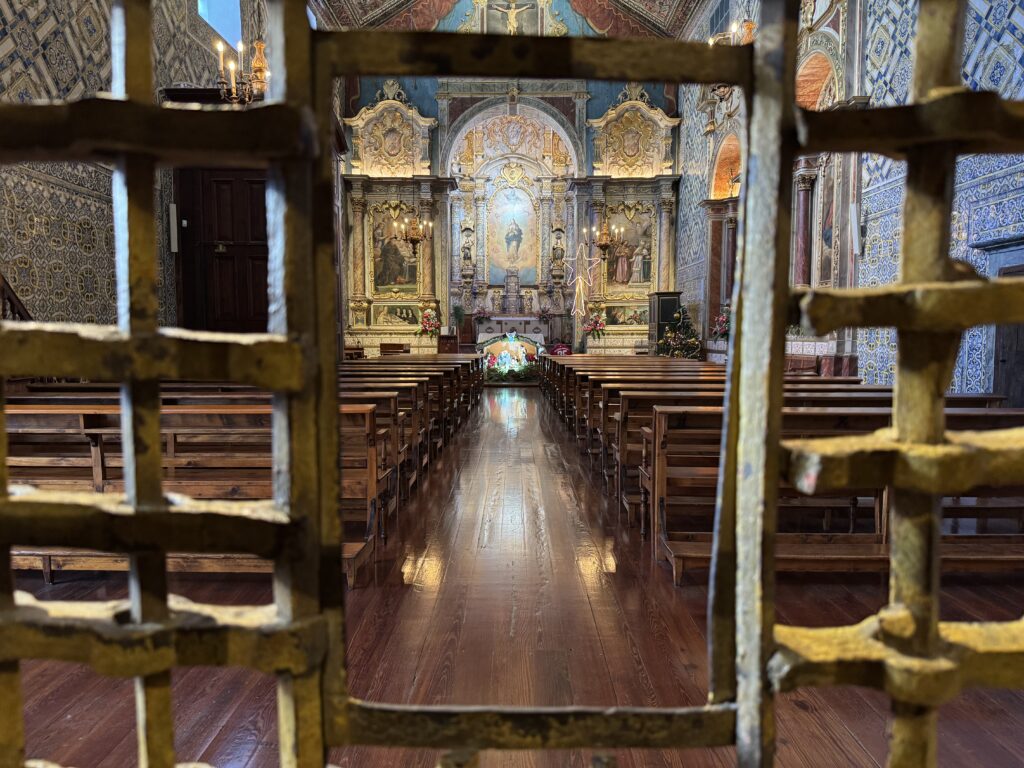
Voor wie even wil ontsnappen aan de levendigheid van de stad, is het Santa Clara-klooster een plek van rust. Dit vijftiende-eeuwse klooster staat op een heuvel en oogt van buiten eenvoudig, bijna streng. Binnen verrast het met barokke accenten van bladgoud en muren bekleed met kleurrijke tegels uit Sevilla. Kapellen tonen schilderijen in maniëristische stijl, met felle kleuren en gedraaide lichamen die een verhaal vertellen. Generaties dochters van aristocratische families woonden hier volgens de eenvoudige regels van het kloosterleven, en toch voelt het hier niet zwaar. Het contrast tussen ingetogen muren en weelderige kunst maakt deze plek juist bijzonder.
Madeira-wijn en geduld
Funchal kent geen haast, zeker niet als het om eten en drinken gaat. Madeira-wijn, het beroemdste exportproduct van het eiland, heeft jaren nodig om te rijpen, en wordt daardoor met elke slok rijker en voller. Ook de keuken weerspiegelt die liefde voor traditie: espetada, vleesspiesen langzaam geroosterd boven houtvuur, of espada com banana, de verrassende combinatie van zwarte degenvis met zoete banaan.
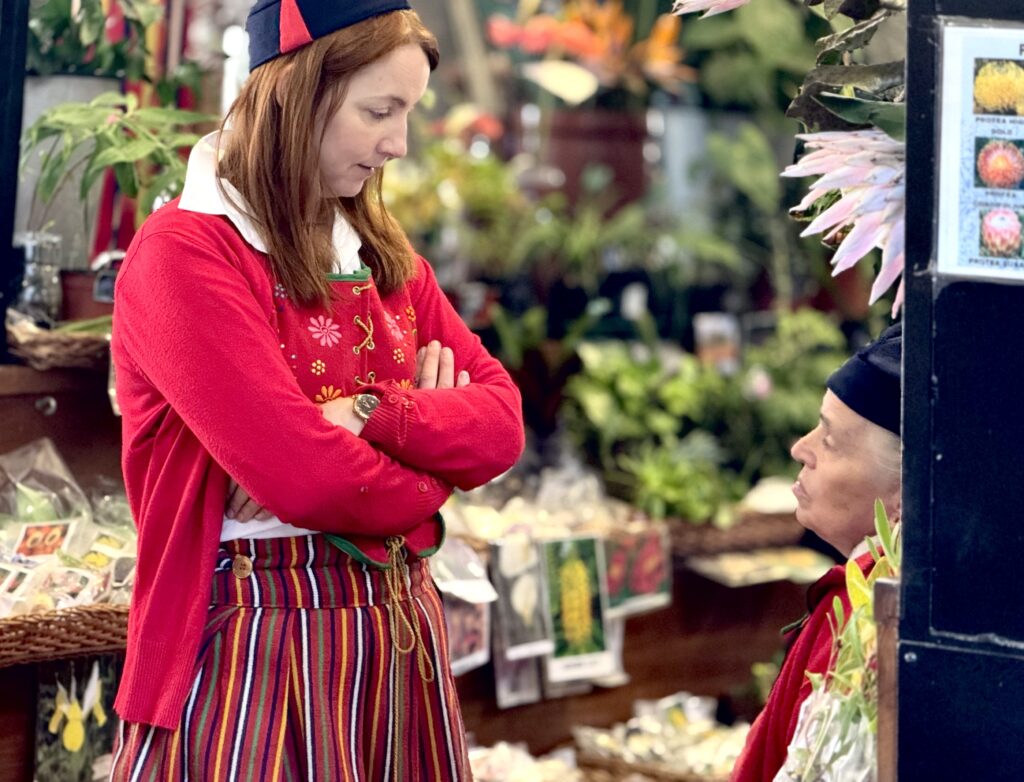
Terug bij de markthal zit een vrouw in traditionele klederdracht, haar rok met kleurrijke strepen zachtjes meebewegend op het ritme van haar handen. Voor haar ligt een stapel paradijsvogelbloemen. Met een vanzelfsprekende gratie bindt ze de bloemen samen tot een bundel, kijkt op, glimlacht kort en gaat weer verder met haar werk. Hier, in Funchal, loopt de tijd niet weg. Ze blijft gewoon even bij ons.
The mist folds over the terracotta roofs of Funchal, and a soft breeze carries the smell of freshly baked bolo do caco with it. In the capital of Madeira nothing moves fast, and that is exactly the point. No grand monuments or crowded lists of must-sees, just winding streets where we stumble onto something without trying.
The rhythm of Funchal
Madeira has drawn travelers seeking rest for centuries. The volcanic island offers mountains, seas of flowers and views from high cliffs, while Funchal spreads like a colorful patchwork across the hills, looking out over deep blue water. Founded in the fifteenth century by Portuguese explorers, the city takes its name from the fennel that once grew everywhere here.
The art of slowing down
In Funchal one golden rule applies: let our senses lead the way. We wander without a plan through streets paved in basalt. A colorful tiled wall, the smell of freshly ground coffee, an accordion player on a sun-drenched square. We slow down and notice things we would otherwise miss, like a hidden door leading to a green courtyard at the Casa Museu Frederico de Freitas, or a local pointing us toward the best spot for a glass of Madeira wine. The only decision left is sweet, medium or dry.
“This is not about trying to see everything, it is about seeing more by doing less.”
A morning at Mercado dos Lavradores
No visit to Funchal is complete without a morning at Mercado dos Lavradores. This market hall is a spectacle of color and smell, stalls piled high with passion fruit, papayas and fresh dates with walnuts. Vendors call out their goods, fishermen lay out their catch, silver scales glinting in the morning light. We take our time, look around and taste above all: a slice of bolo de mel, a bite of custard apple. This is how we get to know the food, but also the craftsmanship and traditions of the island.
Stillness at the Santa Clara Convent
For anyone looking to escape the liveliness of the city, the Santa Clara Convent offers a place of rest. This fifteenth century convent sits on a hill and looks plain, almost austere from outside. Inside it surprises with baroque touches of gold leaf and walls covered in colorful tiles from Seville. Chapels display paintings in mannerist style, with bold colors and twisted figures telling their own story. Generations of daughters from aristocratic families lived here under the simple rules of convent life, and yet nothing here feels heavy. The contrast between restrained walls and lavish art is exactly what makes this place stand out.
Madeira wine and patience
Funchal knows no rush, especially not when it comes to food and drink. Madeira wine, the island’s most famous export, needs years to mature, growing richer and fuller with every passing season. The kitchen reflects that same devotion to tradition: espetada, skewers of meat slowly roasted over an open wood fire, or espada com banana, the surprising pairing of black scabbardfish with sweet banana.
Back at the market hall, a woman in traditional dress sits with her striped skirt moving gently with the rhythm of her hands. In front of her lies a stack of bird of paradise flowers. With an easy grace she ties the flowers into a bundle, looks up, smiles briefly and goes back to her work. Here in Funchal, time does not slip away. It simply stays with us for a while.
Slow travel in Funchal bezoeken, dit moet je weten
De Mercado dos Lavradores aan de Largo dos Lavradores 9060-158 is de plek waar Funchal wakker wordt. Maandag tot en met vrijdag open van 7:00 tot 19:00 uur, zaterdag tot 14:00 uur, zondag gesloten. Toegang is gratis. Kom vrijdagochtend voor de meeste sfeer, met de vismarkt op zijn drukst en bloemenverkoopsters in traditionele kleding. Prijzen liggen soms hoger bij de trappen van de ingang, dus wandel eerst rond en vergelijk.
Funchal is compact en het historische centrum is prima te belopen. Voor de heuvels neem je de Teleférico do Funchal vanaf Almirante Reis naar Monte, ongeveer vijftien minuten omhoog met uitzicht over de baai. Terug per rieten slee is een klassieker sinds de negentiende eeuw. Kies restaurants op reservering in de wijk Zona Velha en probeer poncha, de traditionele Madeirese cocktail van rum, honing en citroen. Espetada aan een lauwrierstok is de streekklassieker.
Vaakgestelde vragen over Funchal
Wat kost een bezoek aan de markt?
Toegang tot de Mercado dos Lavradores is gratis. Neem cash mee voor kleine aankopen zoals fruit en bloemen. Proeven bij de vismarkt is gebruikelijk, vragen mag altijd.
Wanneer is de markt op zijn levendigst?
Vrijdagochtend, wanneer boeren van het eiland verse waar aanvoeren en de vismarkt op zijn drukst is. Kom voor 10:00 uur voor de beste sfeer.
Hoe kom ik van Funchal Airport naar het centrum?
De aerobus lijn 208 rijdt elk half uur en kost circa vijf euro per rit. Een taxi doet ongeveer vijfentwintig tot dertig euro. De rit duurt een klein half uur.
Is Funchal geschikt voor slow travel?
Absoluut. Het compacte centrum, de eeuwenoude straatjes en het klimaat maken slenteren aangenaam. Plan één tot twee bezienswaardigheden per dag en laat tijd over voor koffie en gesprek.
Wat drink je in Funchal?
Poncha (rum, honing, citroensap) is de klassieker. Madeirawijn kies je zoet, medium of dry. Beide zijn onderdeel van elke tafel in de Zona Velha.
Wanneer is het beste seizoen?
Madeira heet niet voor niets het eiland van de eeuwige lente. Temperaturen liggen jaarrond tussen zestien en vierentwintig graden. Voor het minste toerisme kom je in april, mei of oktober.
Meer uit Madeira
Over Elle
Elle Verbeek is reisjournalist en purser bij KLM. Ze schrijft columns en reisverhalen, deels voor eigen platform, deels voor Nederlandse magazines. Op Ellevie Travels deelt ze reisreportages van de bestemmingen waar ze naartoe vliegt of waar ze zelf naartoe reist.
Visiting Funchal for slow travel: what to know
The Mercado dos Lavradores at Largo dos Lavradores 9060-158 is where Funchal wakes up. Open Monday through Friday from 7 a.m. to 7 p.m., Saturday until 2 p.m., closed Sundays. Entry is free. Come on Friday morning for the busiest atmosphere, with the fish market at peak and flower sellers in traditional dress. Prices near the entrance stairs can run higher, so browse before you buy.
Funchal is compact and the historic centre is easy to walk. For the hills, take the Teleférico do Funchal from Almirante Reis up to Monte, about fifteen minutes rising above the bay. Coming back down by wicker toboggan has been a Funchal tradition since the nineteenth century. Book restaurants in advance in the Zona Velha quarter and try poncha, the local cocktail of rum, honey, and lemon. Espetada on a laurel skewer is the regional classic.
Frequently asked questions about Funchal
What does a market visit cost?
Entry to Mercado dos Lavradores is free. Bring cash for small purchases like fruit and flowers. Tasting at the fish market is common, and asking is always fine.
When is the market at its liveliest?
Friday morning, when island farmers bring in fresh produce and the fish market is busiest. Arrive before 10 a.m. for the best atmosphere.
How do I get from Funchal Airport to the centre?
The aerobus line 208 runs every thirty minutes and costs around five euros. A taxi is about twenty-five to thirty euros. The ride takes just under thirty minutes.
Is Funchal good for slow travel?
Absolutely. The compact centre, old streets, and mild climate make wandering pleasant. Plan one or two sights per day and leave room for coffee and conversation.
What should I drink in Funchal?
Poncha (rum, honey, lemon juice) is the classic. Madeira wine comes sweet, medium, or dry. Both belong on any Zona Velha table.
When is the best season to visit?
Madeira is called the island of eternal spring for good reason. Temperatures sit between sixteen and twenty-four degrees Celsius year-round. For fewer tourists, come in April, May, or October.
More from Madeira
About Elle
Elle Verbeek is a travel journalist and KLM purser. She writes columns and travel stories, partly for her own platform, partly for Dutch magazines. On Ellevie Travels she shares reportage from the destinations she flies to or travels to on her own.
Praktische tips uit dit verhaal Practical tips from this story
-
Wandelroute · natuur · Madeira PR9 — Levada do Caldeirão Verde, het lied van het water — Door UNESCO-Laurisilva-bos langs een oud irrigatiekanaal, met tunnels (zaklamp mee!) en een waterval die vanaf 100 meter in een poel stort. Let op: momenteel ingekort tot ca. 4,5 km, check Visit Madeira voor de actuele status.
Hiking trail · nature · Madeira PR9 — Levada do Caldeirão Verde, the song of the water — Through UNESCO Laurisilva forest along an old irrigation channel, with tunnels (bring a flashlight!) and a waterfall crashing 100 metres into a pool. Note: currently shortened to approx. 4.5 km, check Visit Madeira for the latest status.
-
Markthal · eten · Funchal Mercado dos Lavradores — de kleurrijke markthal van Funchal — Passievruchten, papaja's en zilveren vissen die glinsteren in het ochtendlicht. Art Deco-gebouw uit 1940 met mozaïeken in blauw, wit en geel. Ga vroeg, proef een plakje bolo de mel.
Market hall · food · Funchal Mercado dos Lavradores — Funchal's colourful market hall — Passion fruit, papayas and silver fish glistening in the morning light. Art Deco building from 1940 with blue, white and yellow mosaics. Go early, try a slice of bolo de mel.
-
Klooster · geschiedenis · Funchal Santa Clara-klooster — rust op een heuvel boven Funchal — 15e-eeuws klooster met blauwe tegels uit Sevilla, bladgoud en schilderijen in maniëristische stijl. Van buiten sober, van binnen verrassend rijk. Twee jaar geleden gerestaureerd.
Convent · history · Funchal Santa Clara Convent — tranquility on a hill above Funchal — 15th-century convent with blue tiles from Seville, gold leaf and mannerist-style paintings. Plain outside, surprisingly rich inside. Restored two years ago.
-
Wandelroute · natuur · Madeira PR6 — 25 Fontes, watervallen en oorverdovende stilte — Eindigt bij een cirkelvormige poel omringd door tientallen watervalletjes — een openluchtamfitheater. Sla de bus vanaf de parking over voor een extra workout van ongeveer 2 km door de kloof.
Hiking trail · nature · Madeira PR6 — 25 Fontes, waterfalls and deafening silence — Ends at a circular pool surrounded by dozens of small waterfalls — an open-air amphitheatre. Skip the bus from the car park for an extra 2 km workout through the gorge.
-
Wandelroute · natuur · Madeira PR8 — Ponta de São Lourenço, woeste kliffen aan de oceaan — Kale rotsen en dramatische kliffen die aflopen naar de Atlantische Oceaan. Halverwege wacht Casa do Sardinha, een groene oase met restaurant. Sinds januari 2025 geldt hier € 3,- entree.
Hiking trail · nature · Madeira PR8 — Ponta de São Lourenço, rugged cliffs by the ocean — Bare rocks and dramatic cliffs dropping into the Atlantic Ocean. Halfway, Casa do Sardinha awaits — a green oasis with a restaurant. Since January 2025, entry costs €3.
-
Natuurlijk zwembad Doca do Cavacas — Vulkanische rotsbaden aan de kust van Funchal, gratis toegankelijk, met stalen trappen het water in. Kalm bij eb, vragen aan de zee bij storm, mooi bij zonsondergang.
Natural pool Doca do Cavacas — Volcanic rock pools on the Funchal coast, free entry, with steel stairs into the water. Calm at low tide, wilder in storms, magical at sunset.