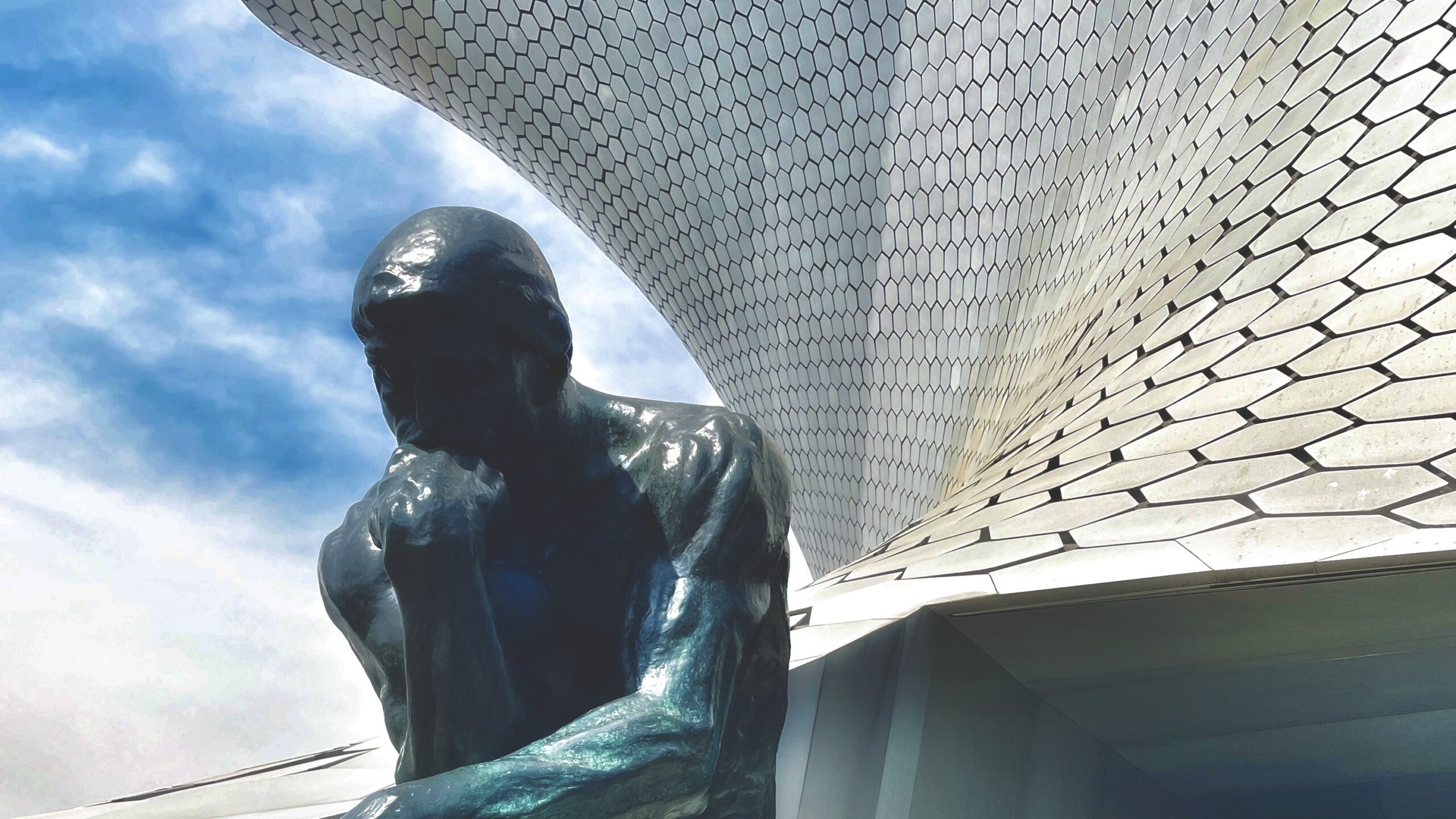
Witte bloembakken scheiden de asfaltwegen van Polanco, buxushagen omlijsten geharkte borders en mannen in fluorescerende hesjes snoeien de perken alsof de wijk zelf op poten staat. Tussen de moderne gevels en gekleurde huizen met sierlijke Franse balkons doemt dan iets op dat niet in die orde past: een gebouw van zestienduizend zeshoekige aluminium tegels, glimmend en zonder rechte hoek. Museo Soumaya.
Een gebouw zonder rechte lijnen
De gevel weerspiegelt de lucht, de voetgangers en het verkeer dat voorbij raast, alsof het gebouw zelf meebeweegt met de stad. Bij de ingang zit Rodins ‘Le Penseur’, klein tegen die enorme glinsterende massa. De toegang is gratis, altijd al geweest, sinds Carlos Slim in 1967 tijdens zijn huwelijksreis kennismaakte met de Europese grootmeesters via zijn vrouw Soumaya. Zij was zijn lerares in de kunst. Het museum draagt haar naam, en wat volgt voelt meer als een liefdesbrief dan als een verzameling.
In de witte hal begroet een replica van Michelangelo’s David ons vanaf de vloer, terwijl Rivera’s muurschilderingen de linkerwand vullen en aan de overkant een zes meter hoge bronzen deur van Rodin oprijst. Driehonderd figuren wringen zich door La Porte de l’Enfer, allemaal op weg naar een onderwereld die niemand hier lijkt te haasten.
Vrouwen van steen, vrouwen van verf
Op de tweede verdieping wemelt het van Griekse godinnen: Venus, Diana, Athena, vrouwe Justitia met haar weegschaal. Zoveel sterke vrouwen op één vloer voelt niet toevallig. Een verdieping hoger hangen honderden Maria’s tegen een indigo muur, omringd door kruisigingen en het heilige hart, en de vraag dringt zich op of dit gaat over geloof, of over een andere moeder: die van Slims zes kinderen.
“Een museum voor een vrouw is meer dan een gebaar, het is een hele verdieping vol gezichten die naar haar lijken te verwijzen.”
Van Mondriaan tot mixografie
Hoger in het gebouw hangen Nederlandse namen tussen de Mexicaanse muren: Van Dongen’s ‘Ville de Trouville sur Mer’, Mondriaans ‘De Molen van Veghel’, een koopvrouw van Isaac Israël op de Prinsengracht. Weer een trap hoger breekt het impressionisme open in penseelstreken van Degas en Monet, weilanden en verten aan zee, voordat de avant-garde de rust verstoort met rauwe vormen en gezichten die schreeuwen zonder geluid.
Op de vijfde verdieping wordt het Mexicaans: Rivera’s sociale strijd in verf, Tamayo’s mixografie die textuur uit doek en papier persruwt, en een verzameling munten uit het pre-Spaanse tijdperk die stilletjes in een hoek ligt te glanzen. Dan, in de laatste zaal, meer dan honderd werken van één man: Rodin. Soumaya’s favoriet, zeggen ze, al vragen sommige critici zich af of het niet gewoon een koopjeshoek is geworden.
Buiten, tussen de tegels
Bij de trap naar buiten blijven een paar bezoekers nog even staan, kijkend naar de zeshoekige tegels van dichtbij, alsof ze willen begrijpen hoe zoveel losse stukjes samen een vorm zonder hoeken kunnen maken. Niemand heeft haast om weg te gaan.
We lopen langs ‘De Denker’ terug naar de uitgang, langs de zilveren huid van het gebouw die inmiddels oranje kleurt in de avondzon. Op straat poetst een portier de glazen deuren, en een stel loopt hand in hand richting de boulevard, hun schaduwen lang uitgerekt over de tegels die de hele wijk in miniatuur weerspiegelen.
White planters divide the asphalt roads of Polanco, boxwood hedges frame raked flower beds and men in fluorescent vests trim the greenery as if the whole neighborhood is standing at attention. Between the modern facades and the colorful houses with ornate French balconies, something rises that doesn’t quite fit: a building made of sixteen thousand hexagonal aluminum tiles, gleaming and without a single straight corner. Museo Soumaya.
A building without straight lines
The facade reflects the sky, the pedestrians and the traffic rushing past, as if the building itself breathes along with the city. At the entrance sits Rodin’s ‘Le Penseur’, small against that enormous glimmering mass. Admission is free, always has been, ever since Carlos Slim met the European masters through his wife Soumaya during their honeymoon in 1967. She was his teacher in art. The museum carries her name, and what follows feels less like a collection and more like a love letter.
In the white hall a replica of Michelangelo’s David greets us from the floor, while Rivera’s murals fill the left wall and across from it a twenty foot bronze door by Rodin rises up. Three hundred figures twist their way through La Porte de l’Enfer, all headed toward an underworld that doesn’t seem to be in any hurry here.
Women of stone, women of paint
On the second floor Greek goddesses crowd the walls: Venus, Diana, Athena, Lady Justice with her scales. So many strong women on one floor doesn’t feel accidental. A floor up, hundreds of paintings of Mary hang against an indigo wall, surrounded by crucifixions and the sacred heart, and the question surfaces whether this is about faith, or about another mother: the one who raised Slim’s six children.
“A museum built for one woman is more than a gesture, it’s an entire floor of faces that seem to point back to her.”
From Mondrian to mixography
Higher up, Dutch names hang among the Mexican walls: Van Dongen’s ‘Ville de Trouville sur Mer’, Mondrian’s ‘The Mill at Veghel’, a merchant woman by Isaac Israels on the Prinsengracht. Another flight up, impressionism breaks open in brushstrokes by Degas and Monet, meadows and distant seascapes, before the avant garde disrupts the calm with raw shapes and faces that scream without a sound.
The fifth floor turns Mexican: Rivera’s social struggles rendered in paint, Tamayo’s mixography pressing texture out of canvas and paper, and a collection of pre Hispanic coins glinting quietly in a corner. Then, in the final room, more than a hundred works by a single man: Rodin. Soumaya’s favorite, they say, though some critics wonder if it isn’t simply a bargain bin dressed up as devotion.
Outside, among the tiles
Near the stairs to the exit, a few visitors linger, studying the hexagonal tiles up close, as if trying to understand how so many small pieces come together to form a shape without corners. Nobody seems in a hurry to leave.
We walk past ‘The Thinker’ back toward the exit, past the silver skin of the building now turning orange in the evening sun. On the street a doorman polishes the glass doors, and a couple walks hand in hand toward the boulevard, their shadows stretched long across the tiles that mirror the entire neighborhood in miniature.


Museo Soumaya bezoeken, dit moet je weten
Museo Soumaya Plaza Carso staat aan Boulevard Miguel de Cervantes Saavedra 303 in Nuevo Polanco (postcode 11529, Miguel Hidalgo). Het futuristisch spiegelende gebouw van architect Fernando Romero (schoonzoon van Carlos Slim) opende in maart 2011. Dagelijks open van 10.30 tot 18.30 uur, 365 dagen per jaar. Toegang is volledig gratis, ook voor buitenlandse bezoekers. Rondom Plaza Carso vind je Museo Jumex, restaurants en winkels.
De collectie beslaat meer dan 66.000 werken uit 30 eeuwen kunstgeschiedenis, waarvan ongeveer tien procent tegelijk wordt geëxposeerd op zes verdiepingen. Highlights zijn de grootste privécollectie Rodin-bronzen buiten Frankrijk (380 werken), Europese meesters zoals Da Vinci, El Greco, Tintoretto en Van Dyck. Ook moderne kunst van Picasso, Monet en Dalí plus Mexicaanse maestros zoals Rivera, Orozco en Tamayo. Ook de grootste muntencollectie uit het onderkoninkrijk. Metro: Line 7 halte Polanco of San Joaquín, dan tien minuten lopen. Trek twee tot drie uur uit voor een grondig bezoek. Doordeweekse ochtenden zijn het rustigst.
Vaakgestelde vragen over Museo Soumaya
Kost een bezoek aan Museo Soumaya geld?
Nee. Toegang is volledig gratis, voor iedereen, elke dag van het jaar. De collectie wordt gefinancierd door de Fundación Carlos Slim.
Wanneer is het museum open?
Elke dag van de week van 10.30 tot 18.30 uur, 365 dagen per jaar. Ook op maandag geopend en met kerst en nieuwjaar.
Waar zit Museo Soumaya?
Plaza Carso op Boulevard Miguel de Cervantes Saavedra 303 in Nuevo Polanco. Er is een tweede locatie in Plaza Loreto (San Ángel) met kortere openingstijden.
Hoe kom ik er met de metro?
Metro Line 7 (oranje) tot halte Polanco of San Joaquín, dan tien tot vijftien minuten lopen. Uber is een goede optie vanuit de meeste toeristische wijken.
Wat zijn de highlights?
De 380 Rodin-bronzen (grootste privécollectie buiten Frankrijk), Europese meesters zoals Da Vinci en El Greco. Ook Mexicaanse muralisten en de grootste muntencollectie uit het onderkoninkrijk. Zes verdiepingen, ongeveer twee uur voor een grondig bezoek.
Zijn er audiogidsen?
Er zijn gratis apps beschikbaar via Google Arts & Culture. In het museum zelf zijn geen audiogidsen. Wel gratis rondleidingen op afspraak; info op museosoumaya.org.
Over Elle
Elle Verbeek is reisjournalist en purser bij KLM. Ze schrijft columns en reisverhalen, deels voor eigen platform, deels voor Nederlandse magazines. Op Ellevie Travels deelt ze reisreportages van de bestemmingen waar ze naartoe vliegt of waar ze zelf naartoe reist.
Meer uit Mexico-Stad
Visiting Museo Soumaya: what to know
Museo Soumaya Plaza Carso is located at Boulevard Miguel de Cervantes Saavedra 303 in Nuevo Polanco (11529, Miguel Hidalgo). The futuristic mirrored building by architect Fernando Romero (son-in-law of Carlos Slim) opened in March 2011. Open daily from 10:30 AM to 6:30 PM, 365 days a year. Admission is completely free, including for foreign visitors. Around Plaza Carso you’ll find Museo Jumex, restaurants, and shops.
The collection spans more than 66,000 works from 30 centuries of art history, of which about ten percent is on display across six floors. Highlights include the largest private Rodin bronze collection outside France (380 works), European masters like Da Vinci, El Greco, Tintoretto, and Van Dyck, modern art from Picasso, Monet, and Dalí, and Mexican maestros like Rivera, Orozco, and Tamayo. Also the largest coin collection from the Viceroyalty period. Metro: Line 7 to Polanco or San Joaquín, then a ten-minute walk. Allow two to three hours for a thorough visit. Weekday mornings are quietest.
Frequently asked questions about Museo Soumaya
Does a Museo Soumaya visit cost anything?
No. Admission is completely free, for everyone, every day of the year. The collection is funded by the Fundación Carlos Slim.
When is the museum open?
Every day of the week from 10:30 AM to 6:30 PM, 365 days a year. Also open Mondays and on Christmas and New Year.
Where is Museo Soumaya?
Plaza Carso at Boulevard Miguel de Cervantes Saavedra 303 in Nuevo Polanco. There is a second location at Plaza Loreto (San Ángel) with shorter opening hours.
How do I get there by subway?
Metro Line 7 (Orange) to Polanco or San Joaquín, then a ten to fifteen minute walk. Uber is a good option from most tourist neighborhoods.
What are the highlights?
The 380 Rodin bronzes (largest private collection outside France), European masters like Da Vinci and El Greco, Mexican muralists, and the largest coin collection from the Viceroyalty period. Six floors, about two hours for a thorough visit.
Are there audio guides?
Free apps are available through Google Arts & Culture. Inside the museum itself there are no audio guides. Free guided tours are available by appointment; info at museosoumaya.org.
About Elle
Elle Verbeek is a travel journalist and KLM purser. She writes columns and travel stories, partly for her own platform, partly for Dutch magazines. On Ellevie Travels she shares reportage from the destinations she flies to or travels to on her own.
More from Mexico City
Praktische tips uit dit verhaal Practical tips from this story
-
Archeologische zone · piramides · Unesco Teotihuacán — de plek waar de goden werden geschapen — De piramides van de Zon en de Maan met de Laan van de Doden ertussen. Bestijgen mag sinds 2024 niet meer, wel wandelen tussen de tempels waarin duizenden jaren geschiedenis samenkomen. inah.gob.mx · meer info
Archaeological site · pyramids · Unesco Teotihuacán — where the gods were created — The Pyramids of the Sun and the Moon flanking the Avenue of the Dead. Climbing has been prohibited since 2024, but you can walk among the temples where millennia of history converge. inah.gob.mx · more info
-
Stadspark Chapultepec Park — Het antropologisch museum ligt in dit enorme park, twee keer zo groot als Central Park. Roeibootjes op het meer, kasteel op de heuvel, ijsverkopers overal.
City park Chapultepec Park — The anthropology museum sits inside this enormous park, twice the size of Central Park. Rowboats on the lake, castle on the hill, ice cream sellers everywhere.
-
Natuurreservaat · vlinders · Mexico Piedra Herrada — miljoenen monarchvlinders in de bergen — Ga op een doordeweekse zonnige dag: dan zijn de vlinders het actiefst en is het rustig. De laatste 45 minuten omhoog zijn steil, wandelstokken helpen. Boek de tour via gids Leonel Rivera.
Nature reserve · butterflies · Mexico Piedra Herrada — millions of monarch butterflies in the mountains — Go on a sunny weekday: the butterflies are most active then and it's quiet. The final 45 minutes uphill are steep, walking sticks help. Book the tour through guide Leonel Rivera.
-
Vlindersanctuarium Santuario El Rosario — Het grootste monarchvlinder-reservaat, iets verder rijden dan Piedra Herrada maar met veel meer vlinders. Klim omhoog naar drieduizend meter, laag zuurstof, hoog wonder.
Butterfly sanctuary Santuario El Rosario — The largest monarch reserve, a longer drive than Piedra Herrada but with many more butterflies. Climb to three thousand meters: low oxygen, high wonder.
-
Restaurant · Mexicaans Restaurant Museo Nacional de Antropología — Op de begane grond van het museum. Nacho's met guacamole na een halve dag zalen — ideaal om alle beelden en verhalen rustig te laten zakken voor je weer de stad in stapt. mna.inah.gob.mx · meer info
Restaurant · Mexican Restaurant Museo Nacional de Antropología — On the ground floor of the museum. Nachos with guacamole after half a day of galleries — the perfect place to let all the images and stories settle before heading back into the city. mna.inah.gob.mx · more info
-
Museum · precolumbiaanse cultuur Museo Nacional de Antropología — 23 zalen onder de betonnen paraplu van Pedro Ramírez Vázquez — van de Azteekse Zonnesteen en de replica's van de piramides van Teotihuacán tot Maya-hutten en handelsschepen langs de Golfkust. Reken minimaal drie uur. mna.inah.gob.mx · meer info
Museum · pre-Columbian culture Museo Nacional de Antropología — 23 rooms under Pedro Ramírez Vázquez's concrete umbrella — from the Aztec Sun Stone and replicas of Teotihuacán's pyramids to Maya huts and Gulf Coast trade ships. Allow at least three hours. mna.inah.gob.mx · more info