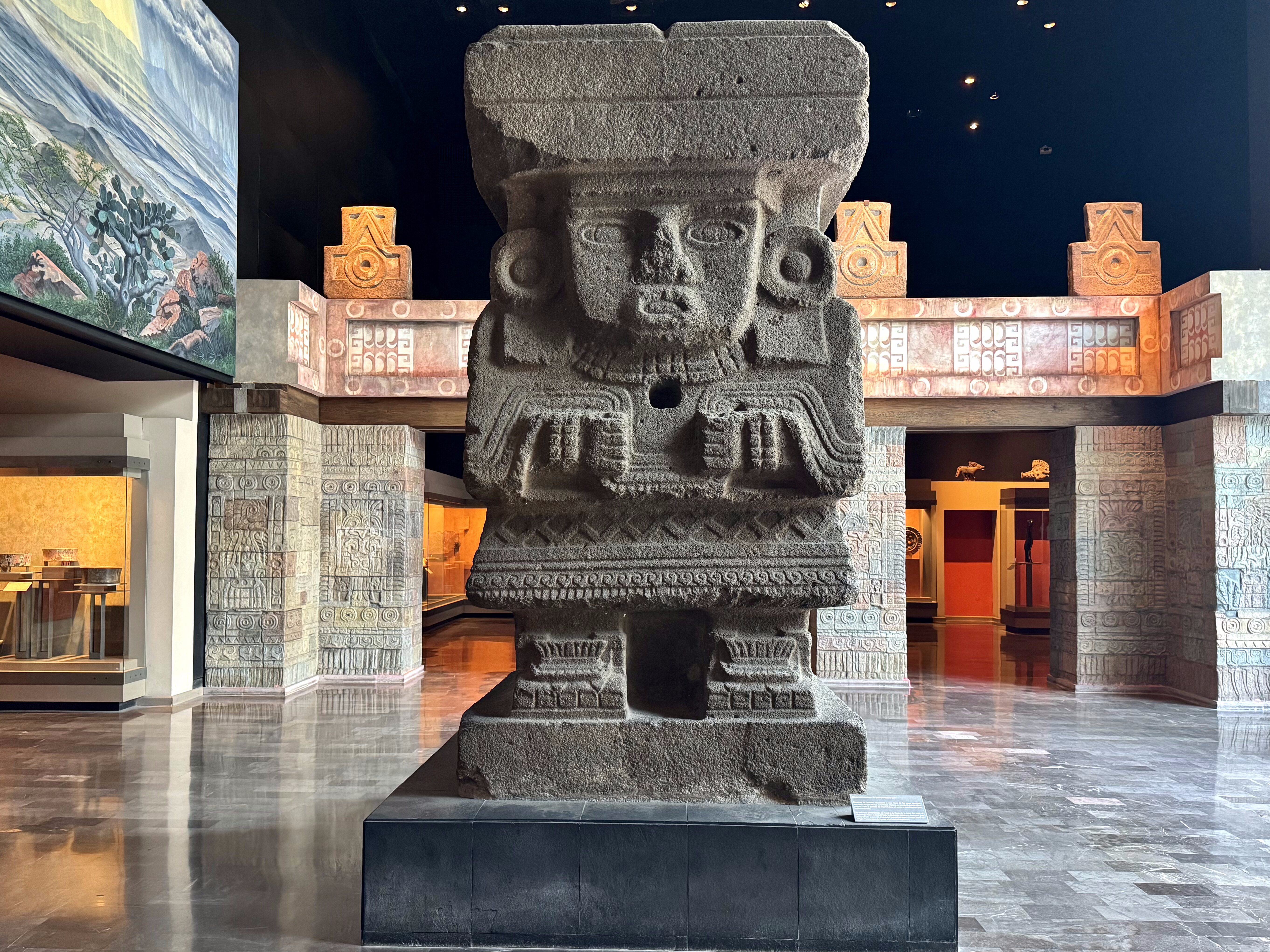
Op de binnenplaats voor ons rust een betonnen dak op één pilaar. Rondom stroomt water naar beneden, als langs de rand van een paraplu. Precies wat architect Pedro Ramírez Vázquez bedoelde: een symbool van beschutting en behoud van Mexicaanse cultuur. We zijn in het antropologisch museum van Mexico-Stad, klaar om de eerste zaal in te lopen.
“Eén woord en de donkere hut wordt iets koninklijks.”
De hut die keuken, altaar en hart is
Tlillancalco, staat er. Eén zin, maar hij verandert de donkere hut voor ons in iets koninklijks, iets heiligs. De geur van steen is licht vochtig en koel, alsof we een grot binnenstappen. Stemmen in Spaans, Engels en andere talen mengen zich tot geroezemoes. Voor ons ligt wat over is van een hut van palm en klei, stukken van een traditionele Maya-woning. De hut is tegelijk keuken, altaar en ritueel hart. Hier brandt het vuur, hier staan heiligenbeelden en Maya-symbolen, hier fluistert het verleden de familieverhalen. Hedendaagse Maya’s wonen nog steeds in vergelijkbare huizen.
Duizenden jaren in stenen reliëfs
Onze ogen wennen langzaam aan het licht. Details springen uit de stenen reliëfs: inkepingen, gezichten, symbolen die we nog niet begrijpen maar ons meteen nieuwsgierig maken. In één dierfiguur zien we een katachtige, puma, jaguar of lynx, jager en symbool van kracht en moed. Onze pas vertraagt. We kijken. Alles wat we hier zien, wortelt duizenden jaren terug. De Maya-cultuur ontstaat rond 2000 voor Christus in Midden-Amerika, bloeit eeuwen later op en wordt pas echt gebroken met de Spaanse verovering. Steden groeien, vallen, komen terug. Oorlog begint als ritueel spel tussen elites, maar eindigt in totale strijd die hele regio’s meesleurt.
“Van fluisteren rond de haard ga je naar stemmen die naar de hemel reiken.”
Piramides voor een hele stad
Verderop sturen plattegronden en pijlen ons naar de volgende zaal. De wereld wordt groter, de ruimte om ons heen rekt uit. Dan staan ze er ineens: replica’s van de piramides van de Zon en de Maan. Waar de zwarte hut een huis was voor één vuur en één familie, zijn dit hele stenen bergen voor een stad. Dezelfde wens blijft: gezien worden door de goden.
De piramides vormen het hart van Teotihuacán, zo’n vijftig kilometer ten noordoosten van Mexico-Stad. De naam betekent de plaats waar de goden werden geschapen; volgens latere tradities is dit de plek waar de zon en maan ontstonden, met de Laan van de Doden ertussen. De piramide van de Zon is verbonden met vruchtbaarheid en onderwereldrituelen, georiënteerd op de baan van de zon. Aan het noordelijke uiteinde staat de piramide van de Maan, iets hoger in de vallei, waar graven en offers zijn gevonden.
Van rook boven een hut tot rook boven een piramide
Vanuit de piramides voert het pad ons naar de kust, naar schepen, zout en markten langs de Golf van Mexico. In de zalen over kano’s, schelpen en handelswaar zien we hoe de rook uit een hut verbonden raakt met de rook van offers boven de piramides. Alles stroomt via zee en kuststeden naar de heilige centra in het binnenland.
Onze wandeling door het museum wordt één beweging: van huisvuur naar wereldrijk, van zwarte hut naar zon en maan. Als we weer onder de betonnen regen staan en Mexico-Stad om de hoek toetert, lopen we naar beneden. De ober zet nacho’s op tafel, guacamole in een houten kom, mijn maag rammelt.
On the courtyard in front of us, a concrete roof rests on a single pillar. Water streams down around it, like rain along the edge of an umbrella. Exactly what architect Pedro Ramírez Vázquez intended, a symbol of shelter and the preservation of Mexican culture. We are standing at the National Museum of Anthropology in Mexico City, about to walk into the first room.
“One word, and the dark hut becomes something regal.”
The hut that is kitchen, altar and heart
Tlillancalco, the sign reads. One sentence, and it transforms the dark hut in front of us into something regal, something sacred. The air smells faintly of damp stone and coolness, as if we are stepping into a cave. Voices in Spanish, English and other languages blend into a low hum. Before us sits what remains of a hut made of palm and clay, fragments of a traditional Maya home. The hut is kitchen, altar and ritual heart all at once. Here the fire burns, here saints and Maya symbols stand watch, here the past whispers family stories. Present-day Maya communities still live in homes much like this one.
Thousands of years in stone relief
Our eyes slowly adjust to the light. Details leap out of the stone reliefs, notches, faces, symbols we do not yet understand but that pull our curiosity forward anyway. In one animal figure we recognize a cat, a puma, jaguar or lynx, hunter and symbol of strength and courage. Our pace slows. We look. Everything here traces back thousands of years. Maya culture emerges around 2000 BCE in Central America, flourishes centuries later, and is only truly broken by the Spanish conquest. Cities rise, fall, return. War begins as a ritual contest between elites but ends as total conflict that drags entire regions along with it.
“From whispering around the hearth to voices reaching for the sky.”
Pyramids built for an entire city
Further along, floor plans and arrows guide us to the next room. The world grows larger, the space around us stretches out. Then suddenly there they are, replicas of the pyramids of the Sun and the Moon. Where the black hut was a home for one fire and one family, these are entire stone mountains built for a city. The same wish remains, to be seen by the gods.
The pyramids form the heart of Teotihuacán, roughly thirty miles northeast of Mexico City. The name means the place where the gods were created; later tradition holds this is where the sun and moon themselves came into being, with the Avenue of the Dead running between them. The Pyramid of the Sun is tied to fertility and underworld rituals, oriented to the path of the sun. At the northern end stands the Pyramid of the Moon, sitting slightly higher in the valley, where graves and offerings have been found.
From smoke over a hut to smoke over a pyramid
From the pyramids, the path leads toward the coast, toward ships, salt and markets along the Gulf of Mexico. In the rooms devoted to canoes, shells and trade goods, we see how the smoke from a hut connects to the smoke of offerings above the pyramids. Everything flows through sea routes and coastal cities toward the sacred centers inland.
Our walk through the museum becomes one continuous motion, from household fire to empire, from black hut to sun and moon. When we step back under the concrete umbrella and Mexico City honks around the corner, we head downstairs. The waiter sets nachos on the table, guacamole in a wooden bowl, my stomach rumbles.

Museo Nacional de Antropología bezoeken, dit moet je weten
Het museum ligt aan Paseo de la Reforma bij Calzada Gandhi in Chapultepec Park (postcode 11560, Miguel Hidalgo). Open van dinsdag tot en met zondag van 9.00 tot 18.00 uur; op maandag gesloten. Vanaf 1 januari 2026 kost een toegangsticket 105 peso voor Mexicaanse ingezetenen en 210 peso voor buitenlandse bezoekers. Op zondag is de toegang gratis voor Mexicaanse ingezetenen en buitenlanders met tijdelijke of permanente Mexicaanse residentie (documento FM), dus reken op grote drukte. Buitenlandse toeristen betalen op zondag het normale tarief. Op alle dagen is de entree ook gratis voor kinderen onder de 13, mensen met een beperking, studenten en leraren met geldig legitimatiebewijs en 60-plussers met INAPAM-kaart.
Bezoek het museum vroeg op een doordeweekse ochtend voor de rustigste ervaring. Gratis rondleidingen in het Spaans en Engels vertrekken dinsdag tot en met zaterdag om 10.30, 12.30, 13.30, 15.00 en 17.00 uur. Reserveren gaat via de museum-app of het onthaal in de lobby. Een audiogids kost 50 peso extra. Metro: Line 7 (oranje) tot Auditorio en 10 tot 15 minuten door het park lopen, of Metrobús Line 7 tot halte Museo Nacional de Antropología pal voor de deur. Trek minimaal drie uur uit, liefst een halve dag, voor de 23 zalen.
Vaakgestelde vragen over Museo Nacional de Antropología
Wat kost een ticket in 2026?
Vanaf 1 januari 2026: 105 peso voor Mexicaanse ingezetenen, 210 peso voor buitenlandse bezoekers. Ongeveer 11 euro voor niet-residenten. Op zondag gratis voor Mexicanen en residenten met documento FM. Buitenlandse toeristen betalen zondag ook.
Wanneer is het museum open?
Dinsdag tot en met zondag van 9.00 tot 18.00 uur. Laatste toegang om 17.00. Gesloten op maandag en op belangrijke nationale feestdagen (1 januari, 1 mei).
Kun je gratis rondleidingen boeken?
Ja. Gratis Spaanse en Engelse rondleidingen vertrekken dinsdag tot en met zaterdag om 10.30, 12.30, 13.30, 15.00 en 17.00 uur. Kaartje afhalen bij het visitor center, afhankelijk van gidsbeschikbaarheid.
Hoeveel tijd moet ik uittrekken?
Minimum drie uur voor de highlights zoals de Aztec Sun Stone en de Maya-zaal, een halve tot volle dag voor het volledige museum met 23 zalen.
Wat is het beste moment van de dag?
Doordeweeks direct bij opening om 9.00. Vermijd zondag: dan is de toegang gratis voor Mexicanen en residenten is het aanzienlijk drukker. Buitenlandse toeristen betalen op zondag alsnog het normale tarief.
Kun je met de metro?
Ja. Line 7 (oranje) tot halte Auditorio, dan 10 tot 15 minuten door Chapultepec Park lopen. Metrobús Line 7 stopt direct voor de deur bij halte Museo Nacional de Antropología.
Over Elle
Elle Verbeek is reisjournalist en purser bij KLM. Ze schrijft columns en reisverhalen, deels voor eigen platform, deels voor Nederlandse magazines. Op Ellevie Travels deelt ze reisreportages van de bestemmingen waar ze naartoe vliegt of waar ze zelf naartoe reist.
Meer uit Mexico-Stad
Visiting Museo Nacional de Antropología: what to know
The museum sits at Paseo de la Reforma and Calzada Gandhi in Chapultepec Park (11560, Miguel Hidalgo). Open Tuesday through Sunday from 9:00 AM to 6:00 PM; closed Mondays. As of January 1, 2026, admission is 105 pesos for Mexican residents and 210 pesos for foreign visitors. Sunday admission is free for Mexican residents and foreigners with temporary or permanent Mexican residency (documento FM), so expect large crowds. Foreign tourists still pay the regular fare on Sundays. On all days, admission is also free for children under 13, people with disabilities, students and teachers with valid ID, and seniors 60+ with an INAPAM card.
Visit early on a weekday morning for the calmest experience. Free guided tours in Spanish and English depart Tuesday through Saturday at 10:30 AM, 12:30 PM, 1:30 PM, 3:00 PM, and 5:00 PM. Book through the museum app or at the visitor desk in the lobby. An audio guide costs 50 pesos extra. Metro: Line 7 (Orange) to Auditorio and a 10 to 15 minute walk through the park, or Metrobús Line 7 to the Museo Nacional de Antropología stop directly in front. Allow at least three hours, preferably half a day, for the 23 halls.
Frequently asked questions about Museo Nacional de Antropología
What does a ticket cost in 2026?
As of January 1, 2026: 105 pesos for Mexican residents, 210 pesos for foreign visitors. About 11 euros for non-residents. Sundays are free for Mexicans and residents with documento FM. Foreign tourists still pay on Sundays.
When is the museum open?
Tuesday through Sunday from 9:00 AM to 6:00 PM. Last entry at 5:00 PM. Closed Mondays and major national holidays (January 1, May 1).
Can you book free guided tours?
Yes. Free Spanish and English tours depart Tuesday through Saturday at 10:30 AM, 12:30 PM, 1:30 PM, 3:00 PM, and 5:00 PM. Sign up at the visitor center, subject to guide availability.
How much time do I need?
Minimum three hours for highlights like the Aztec Sun Stone and Maya hall; half to full day for the complete museum with 23 halls.
What is the best time of day?
Weekdays right at opening at 9:00 AM. Avoid Sundays: admission is free for Mexican residents and holders of Mexican residency then, and the museum is significantly busier. Foreign tourists still pay the regular fare on Sundays.
Can you take the subway?
Yes. Line 7 (Orange) to Auditorio station, then a 10 to 15 minute walk through Chapultepec Park. Metrobús Line 7 stops directly in front at Museo Nacional de Antropología.
About Elle
Elle Verbeek is a travel journalist and KLM purser. She writes columns and travel stories, partly for her own platform, partly for Dutch magazines. On Ellevie Travels she shares reportage from the destinations she flies to or travels to on her own.
More from Mexico City
Praktische tips uit dit verhaal Practical tips from this story
-
Vlindersanctuarium Santuario El Rosario — Het grootste monarchvlinder-reservaat, iets verder rijden dan Piedra Herrada maar met veel meer vlinders. Klim omhoog naar drieduizend meter, laag zuurstof, hoog wonder.
Butterfly sanctuary Santuario El Rosario — The largest monarch reserve, a longer drive than Piedra Herrada but with many more butterflies. Climb to three thousand meters: low oxygen, high wonder.
-
Dorp aan het meer Valle de Bravo — Op vijftien minuten van het vlindersanctuarium ligt dit pittoreske dorp aan een meer. Witte huizen met terracottadaken, kunstenaars, watersport op het water.
Lakeside village Valle de Bravo — Fifteen minutes from the sanctuary sits this picturesque lakeside village. White houses with terracotta roofs, artists, water sports on the lake.
-
Stadspark Chapultepec Park — Het antropologisch museum ligt in dit enorme park, twee keer zo groot als Central Park. Roeibootjes op het meer, kasteel op de heuvel, ijsverkopers overal.
City park Chapultepec Park — The anthropology museum sits inside this enormous park, twice the size of Central Park. Rowboats on the lake, castle on the hill, ice cream sellers everywhere.
-
Museum · precolumbiaanse cultuur Museo Nacional de Antropología — 23 zalen onder de betonnen paraplu van Pedro Ramírez Vázquez — van de Azteekse Zonnesteen en de replica's van de piramides van Teotihuacán tot Maya-hutten en handelsschepen langs de Golfkust. Reken minimaal drie uur. mna.inah.gob.mx · meer info
Museum · pre-Columbian culture Museo Nacional de Antropología — 23 rooms under Pedro Ramírez Vázquez's concrete umbrella — from the Aztec Sun Stone and replicas of Teotihuacán's pyramids to Maya huts and Gulf Coast trade ships. Allow at least three hours. mna.inah.gob.mx · more info
-
Restaurant · Mexicaans Restaurant Museo Nacional de Antropología — Op de begane grond van het museum. Nacho's met guacamole na een halve dag zalen — ideaal om alle beelden en verhalen rustig te laten zakken voor je weer de stad in stapt. mna.inah.gob.mx · meer info
Restaurant · Mexican Restaurant Museo Nacional de Antropología — On the ground floor of the museum. Nachos with guacamole after half a day of galleries — the perfect place to let all the images and stories settle before heading back into the city. mna.inah.gob.mx · more info
-
Archeologische zone · piramides · Unesco Teotihuacán — de plek waar de goden werden geschapen — De piramides van de Zon en de Maan met de Laan van de Doden ertussen. Bestijgen mag sinds 2024 niet meer, wel wandelen tussen de tempels waarin duizenden jaren geschiedenis samenkomen. inah.gob.mx · meer info
Archaeological site · pyramids · Unesco Teotihuacán — where the gods were created — The Pyramids of the Sun and the Moon flanking the Avenue of the Dead. Climbing has been prohibited since 2024, but you can walk among the temples where millennia of history converge. inah.gob.mx · more info