
“No mistakes in the tango. If you make a mistake, get all tangled up, you just tango on.” Die woorden uit Scent of a Woman vatten niet alleen de dans samen, maar ook de stad die ermee vergroeid is. In Buenos Aires is tango een levenshouding: zichtbaar op straat, voelbaar in danszalen en grootser dan ooit in de theaters.
Op Plaza Dorrego, het hart van de wijk San Telmo, vormt zich elke zondagmiddag een kring rond een dansend paar. Tussen antiekstalletjes en terrasstoelen klinkt een krakende bandoneón. Elke misstap verandert moeiteloos in een sierlijke draai. Dit is tango in zijn meest toegankelijke vorm: spontaan, midden in de stad en met een publiek van toevallige voorbijgangers die net hun boodschappen even neerzetten om te kijken.
Oorsprong in de arrabales
De scène in San Telmo herinnert aan waar tango ooit ontstond, in de arrabales, de arme havenwijken van Buenos Aires. Eind negentiende eeuw kwamen hier Europese melodieën samen met Afrikaanse ritmes en Argentijnse volksmuziek. In cafés, bordelen en op straathoeken dansten immigranten en arbeiders op een eenvoudige begeleiding van gitaar en viool.
Wat begon als dans van de onderklasse werd door Parijs opgepikt, waarna Buenos Aires de tango zelf met trots terugnam. Vandaag is tango door UNESCO erkend als immaterieel erfgoed, een symbool van de stad en het land.
De milonga: intiem en met eigen regels
Wie tango wil ervaren zoals de lokale bevolking, bezoekt een milonga. Vaak verscholen achter onopvallende deuren openbaren zich danszalen waar tafeltjes langs de muren staan en de houten vloer wordt vrijgehouden voor koppels. Een uitnodiging gebeurt via een subtiele blik, de cabeceo, en een dans verloopt in een reeks van drie of vier nummers, een tanda.
De milonga is meer dan dans, het is een sociale microkosmos met eigen codes en etiquette. Waar vroeger de man leidde en de vrouw volgde, zien we nu ook vrouwen die leiden, mannen die volgen en queer milonga’s waar rollen bewust worden doorbroken. De essentie blijft hetzelfde: de omhelzing, el abrazo, en de dialoog tussen twee lichamen op muziek van orkesten die soms al een eeuw oud zijn.
“Fouten bestaan niet, je tango’t gewoon door,” zei Frank Slade ooit, en in elke milonga van deze stad blijkt dat nog steeds waar.
Van café tot dinnershow
Een ander gezicht van tango zien we in het iconische Café Tortoni aan de Avenida de Mayo. Dit café uit 1858, met glas-in-loodramen en marmeren vloeren, doet denken aan een oud Frans etablissement. Por una cabeza schalt door de microfoon. Hoewel het toeristisch aandoet, geeft Tortoni nog altijd de grandeur van tango’s gloriedagen weer.
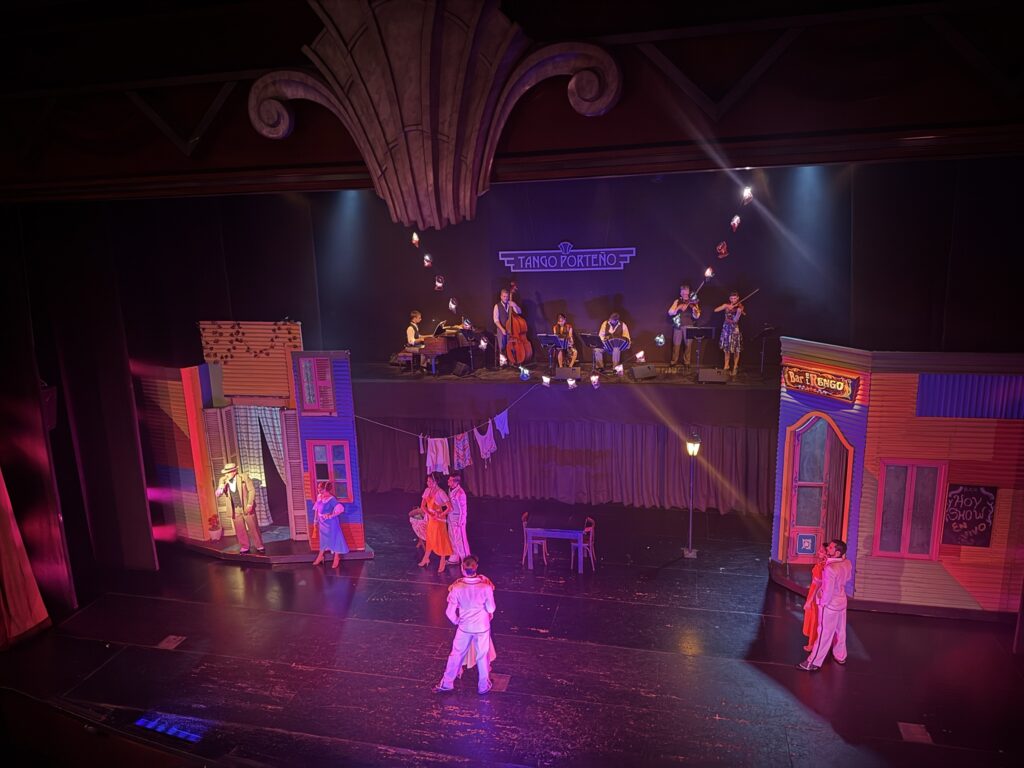
Voor wie het nog groter wil, is er Tango Porteño, een voormalige bioscoop vlakbij Teatro Colón. Terwijl het publiek dineert, voeren tientallen dansers, zangers en een orkest een revue op die de geschiedenis van de dans samenvat. Het is glitter en glamour, ver verwijderd van de intimiteit van de milonga, maar onmiskenbaar indrukwekkend.
Een stad in drie lagen
Straattango in San Telmo, de intimiteit van een milonga en de grandeur van Tortoni en Tango Porteño vormen samen een portret van Buenos Aires in drie lagen. De dans laat zien hoe de stad leeft met haar verleden, improviseert in het heden en schittert op het wereldtoneel.
Op Plaza Dorrego valt tegen de avond de laatste noot van de bandoneón stil. De danser bedankt met een korte buiging, het publiek klapt en valt daarna weer uiteen in losse groepjes die verder wandelen, terwijl een verkoper zijn antieke lampen inpakt voor de volgende zondag.
“No mistakes in the tango. If you make a mistake, get all tangled up, you just tango on.” Those words from Scent of a Woman capture not only the dance but also the city that grew up around it. In Buenos Aires tango is a way of life: visible on the street, felt inside dance halls and grander than ever inside the theaters.
At Plaza Dorrego, the heart of the San Telmo neighborhood, a circle forms every Sunday afternoon around a dancing couple. Between antique stalls and cafe chairs, a creaking bandoneon plays. Every stumble turns effortlessly into a graceful spin. This is tango in its most accessible form: spontaneous, right in the middle of the city, with an audience of passersby who set down their shopping bags just to watch for a while.
Origins in the arrabales
The scene in San Telmo echoes where tango was actually born, in the arrabales, the poor port neighborhoods of Buenos Aires. In the late nineteenth century, European melodies met African rhythms and Argentine folk music here. In cafes, brothels and on street corners, immigrants and laborers danced to simple guitar and violin accompaniment.
What began as a dance of the working class was discovered by Paris, after which Buenos Aires embraced tango right back with pride. Today tango is recognized by UNESCO as intangible heritage, a symbol of both the city and the country.
The milonga: intimate, with its own rules
Anyone who wants to experience tango the way locals do visits a milonga. Often hidden behind unremarkable doors, these dance halls open up with tables lining the walls and the wooden floor kept clear for couples. An invitation happens through a subtle glance, the cabeceo, and a dance unfolds across a set of three or four songs, a tanda.
The milonga is more than dance, it is a social microcosm with its own codes and etiquette. Where once the man led and the woman followed, we now also see women leading, men following, and queer milongas where roles are deliberately broken apart. The essence stays the same: the embrace, el abrazo, and the dialogue between two bodies set to music from orchestras that are sometimes a century old.
“There are no mistakes, you just tango on,” Frank Slade once said, and inside every milonga in this city that still holds true.
From cafe to dinner show
Another face of tango, we find inside the iconic Cafe Tortoni on Avenida de Mayo. This cafe, dating from 1858, with stained glass windows and marble floors, calls to mind an old French establishment. Por una cabeza plays over the speakers. Though it feels touristy, Tortoni still channels the grandeur of tango’s golden days.
For those wanting something bigger, there is Tango Porteño, a former movie theater near Teatro Colon. While the audience dines, dozens of dancers, singers and a full orchestra perform a revue that sums up the dance’s entire history. It is glitter and glamour, far removed from the intimacy of the milonga, but undeniably impressive.
A city in three layers
Street tango in San Telmo, the intimacy of a milonga, and the grandeur of Tortoni and Tango Porteño together form a three layered portrait of Buenos Aires. The dance shows how the city lives with its past, improvises in the present and shines on the world stage.
At Plaza Dorrego, as evening falls, the last note of the bandoneon fades. The dancer thanks the crowd with a quick bow, the audience applauds and then scatters into small groups walking on, while a vendor packs up his antique lamps for next Sunday.

Tango in Buenos Aires beleven, dit moet je weten
Er zijn drie manieren om tango in de stad te zien: op straat in San Telmo, in de milonga’s van Almagro, Palermo en Balvanera; ook in de grote theatershows in het centrum. Elke laag heeft zijn eigen tempo en zijn eigen prijskaartje.
Op zondagmiddag verzamelen dansers op Plaza Dorrego in San Telmo, terwijl de antiekmarkt de kraampjes opruimt. Om zes uur begint La Milonga del Indio in de openlucht; gratis, informeel en niet zo strak als binnen. Doordeweeks danst er meestal een professioneel duo op fooien tijdens de middag.
Voor milonga’s houden we de Mapa Milonguero 2026 van de stad Buenos Aires aan. De klassiekers: Salón Canning (Scalabrini Ortiz 1331) op maandag en dinsdag, La Catedral (Sarmiento 4006) op maandag, El Beso (Riobamba 416) op zondag; La Viruta (Armenia 1366) op vrijdag en zaterdag. Entree ligt tussen tien en achttien euro; kom om negen uur voor de les, blijf om half elf voor de milonga.
Voor een theatershow gaan we naar Teatro Colón. Rondleidingen van vijftig minuten kosten vierendertigduizend Argentijnse peso voor niet-residenten en vertrekken elke vijftien minuten van maandag tot en met zondag, tussen tien ’s ochtends en kwart voor vijf ’s middags. Voor een tango-avond zelf zijn Café de los Angelitos, Piazzolla Tango en El Viejo Almacén in San Telmo herkenbare adressen.
Vaakgestelde vragen over tango in Buenos Aires
Waar zien we gratis tango?
Op Plaza Dorrego op zondag vanaf zes uur, bij La Glorieta de Belgrano in de zomer; op de zaterdag- en zondagavonden op Barrancas de Belgrano. Op de Feria van San Telmo dansen doordeweekse professionals op fooien.
Kunnen we zelf leren dansen?
Ja. Bijna elke milonga begint met een les van een uur voor beginners, meestal in het Engels op verzoek. La Viruta en Salón Canning zijn toegankelijk voor absolute beginners.
Is er een dresscode?
In traditionele milonga’s zoals El Beso en Salón Canning is een nette look de norm: mannen in overhemd, vrouwen in jurk of nette broek. La Viruta en La Catedral zijn losser; sneakers en spijkerbroek werken daar prima.
Wat is cabeceo?
De blikuitwisseling waarmee mannen in traditionele milonga’s dames ten dans vragen. Direct aan tafel vragen wordt als onbeleefd gezien; wie mee wil doen, leert de code eerst kennen.
Hoe laat gaat een milonga door?
De meeste beginnen om tien ’s avonds en lopen door tot drie of vier uur ’s ochtends. La Viruta gaat gratis binnen na twee uur op weekavonden.
Zijn er tango-shows overdag?
De meeste dinner shows starten om acht ’s avonds, maar Confitería Ideal aan Suipacha 384 organiseert middagmilonga’s van drie tot zes. Ook mooi voor wie vroeger op bed wil.
Over Elle
Elle Verbeek is reisjournalist en purser bij KLM. Ze schrijft columns en reisverhalen, deels voor eigen platform, deels voor Nederlandse magazines. Op Ellevie Travels deelt ze reisreportages van de bestemmingen waar ze naartoe vliegt of waar ze zelf naartoe reist.
Meer uit Buenos Aires
Experiencing tango in Buenos Aires: what to know
There are three ways to see tango in the city: on the streets of San Telmo, in the milongas of Almagro, Palermo and Balvanera, and in the big theater shows downtown. Each layer has its own pace and its own price tag.
On Sunday afternoons, dancers gather at Plaza Dorrego in San Telmo as the antique market packs up its stalls. At six pm the outdoor Milonga del Indio starts — free, informal, and less strict than the indoor scenes. On weekdays, a professional couple usually dances for tips during the afternoon.
For milongas, we follow the Mapa Milonguero 2026 published by the city of Buenos Aires. The classics: Salón Canning (Scalabrini Ortiz 1331) on Monday and Tuesday, La Catedral (Sarmiento 4006) on Monday, El Beso (Riobamba 416) on Sunday, and La Viruta (Armenia 1366) on Friday and Saturday. Entry runs from ten to eighteen euros; arrive at nine for the class, stay for the ten-thirty milonga.
For a theater show, head to Teatro Colón. Fifty-minute guided tours cost 34,000 Argentine pesos for non-residents and depart every fifteen minutes Monday through Sunday, from ten am to four forty-five pm. For an evening tango show, Café de los Angelitos, Piazzolla Tango, and El Viejo Almacén in San Telmo are the recognizable venues.
Frequently asked questions about tango in Buenos Aires
Where can we see free tango?
At Plaza Dorrego on Sundays from six pm, at La Glorieta de Belgrano in summer, and at Barrancas de Belgrano on Saturday and Sunday evenings. On weekdays, professionals dance for tips at the San Telmo Fair.
Can we learn to dance ourselves?
Yes. Almost every milonga starts with an hour-long class for beginners, often in English on request. La Viruta and Salón Canning are accessible for absolute beginners.
Is there a dress code?
Traditional milongas like El Beso and Salón Canning expect neat attire: men in shirts, women in dresses or dressy trousers. La Viruta and La Catedral are looser, where sneakers and jeans are fine.
What is cabeceo?
The eye contact ritual through which men in traditional milongas invite women to dance. Asking directly at the table is considered rude; anyone joining the floor should learn the code first.
How late does a milonga go?
Most start at ten pm and continue until three or four am. La Viruta is free after 2 am on weekday nights.
Are there tango shows during the day?
Most dinner shows begin at eight pm, but Confitería Ideal at Suipacha 384 hosts afternoon milongas from three to six. Great for anyone who wants to be in bed earlier.
About Elle
Elle Verbeek is a travel journalist and KLM purser. She writes columns and travel stories, partly for her own platform, partly for Dutch magazines. On Ellevie Travels she shares reportage from the destinations she flies to or travels to on her own.
More from Buenos Aires
Praktische tips uit dit verhaal Practical tips from this story
-
Tangoshow met diner Tango Porteño — Groot art-decopodium, 30-koppig ensemble, zestien dansers en een steak-diner. Toeristisch én goed — als je maar één tangoshow doet. tangoporteno.com.ar · @tangoportenoba · reserveren · meer info
Tango dinner show Tango Porteño — Grand art-deco venue, 30-piece ensemble, sixteen dancers and a steak dinner. Touristy and good — if you only see one show. tangoporteno.com.ar · @tangoportenoba · book · more info
-
Milonga / dansclub La Catedral Club — Grote loods, hoge plafonds, gerecycled meubilair en tango zonder dresscode. Beginnersles vooraf; daarna aanschuiven of van een afstand kijken. @lacatedralclub
Milonga / dance club La Catedral Club — Cavernous warehouse, high ceilings, mismatched furniture and tango without a dress code. Beginner's class first, then dance or watch from the sidelines. @lacatedralclub
-
Kusttrein · panoramische route Tren de la Costa — Route slingert langs parken, villa's en kleine strandjes. Cadeautje van een plan B als je de ferry naar Buenos Aires mist. Stap uit in Acassuso voor een vogelpark en ver uitzicht over de Río de la Plata. trendelacosta.com.ar · meer info
Coastal train · scenic route Tren de la Costa — The route winds past parks, villas and small beaches. A gift of a plan B if you miss the ferry back to Buenos Aires. Get off in Acassuso for a bird park and long views across the Río de la Plata. trendelacosta.com.ar · more info
-
Traditionele milonga Salón Canning — Klassieke tempo, kleine ronde tafels rondom de dansvloer, respect voor de codes. Kom mooi aangekleed en kijk goed naar de cabeceo. @saloncanning
Traditional milonga Salón Canning — Classic tempo, small round tables around the floor, all the traditional codes. Dress nicely and watch the cabeceo carefully. @saloncanning
-
Koffiebar · specialty coffee, Japans geïnspireerd Kissaten Tostador — Verborgen boven een wijnwinkel, klein en zen. De eigenaar — ooit barista in Tokio — brandt zijn bonen zelf, bijna meditatief. Espresso met tonen van cacao en sinaasappelschil; flat white in een zware aardewerken kom. Neem de matcharol erbij. instagram.com · @kissaten.tostador · meer info
Coffee bar · specialty coffee, Japanese-inspired Kissaten Tostador — Hidden above a wine shop, small and calm. The owner — once a barista in Tokyo — roasts his beans himself, almost meditatively. Espresso with notes of cocoa and orange peel; flat white in a heavy stoneware bowl. Order the matcha roll on the side. instagram.com · @kissaten.tostador · more info
-
Milonga · tango · Almagro La Marshall — de queer milonga van Buenos Aires — Rollen wisselen, iedereen is welkom. Start om 21.00 uur met dansles, daarna gaat de milonga door tot laat. hoy-milonga.com · meer info
Milonga · tango · Almagro La Marshall — Buenos Aires' queer milonga — Roles switch freely, everyone is welcome. Starts at 9 PM with a dance lesson, then the milonga continues late into the night. hoy-milonga.com · more info