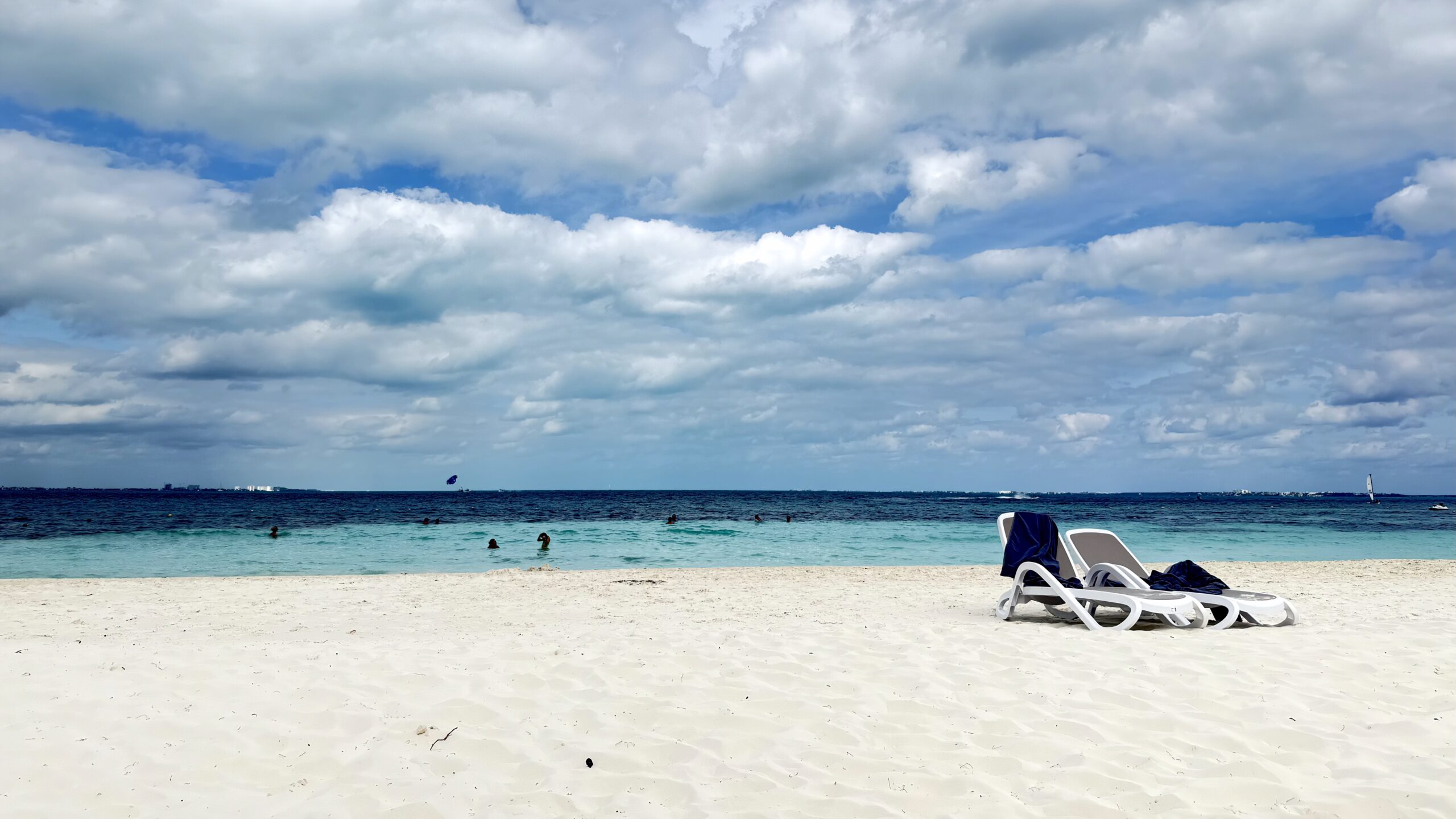
Witte hotels aan het strand, sproeiende fonteinen, wuivende palmbomen. We verlaten alle clichés van Cancún zodra we de boot naar Isla Mujeres nemen. Nou ja, bijna alle clichés: “What a Wonderful World” van Louis Armstrong schalt door de speakers en de lucht ruikt naar zonnebrandcrème en zout. Maar terwijl Cancún langzaam achter ons verdwijnt, verandert er iets.
Een eiland van godinnen en rituelen
Lang voor de veerboten met toeristen af en aan voeren, was Isla Mujeres een heilige plek, gewijd aan Ixchel, de Maya-godin van vruchtbaarheid, genezing en de maan. Maya-vrouwen maakten maandenlange reizen naar dit eiland om te bidden voor een veilige bevalling of helende krachten. De priesteressen die hier woonden, leefden in harmonie met de natuur, gebruikten planten en kruiden voor traditionele genezingen en voerden rituelen uit bij zonsopkomst.
Wanneer toerisme en traditie botsen
Tegenwoordig overspoelt het lawaai van de moderne wereld die magie. Golfkarretjes razen met brommende motoren voorbij, toeristen dragen plastic sombrero’s en winkels puilen uit met neongekleurde souvenirs die weinig met het eiland te maken hebben. Hier en daar drijven lege waterflesjes langs de kust, de moderne versie van een offer waar niemand om gevraagd heeft.
Het is een dubbelzinnig fenomeen. Aan de ene kant biedt het broodnodig werk en inkomen voor de lokale bevolking; families zijn afhankelijk van de hotels, restaurants en winkels die bezoekers bedienen. Maar het massatoerisme eist ook zijn tol op de natuur en de geest van het eiland.
“Het subtiele evenwicht dat de Maya’s zo zorgvuldig bewaakten, lijkt een verre herinnering.”
Playa Norte en Punta Sur
Is Playa Norte het Caribische strand uit je dromen? Wit poederzand, helderblauw water, wuivende palmbomen die schaduw bieden. Beachclubs zoals Zama serveren verse ceviche en koude margarita’s met uitzicht op zee. Puur voelt het niet, niet tussen alle Instagram-fotoshoots.
Bij Punta Sur, waar de kliffen de eerste plek in Mexico zijn waar de zon opkomt, staat de tempel van Ixchel. Lang voor de toeristen kwamen, brachten Maya-vrouwen hier hun offers. Ook hier staan we nu tussen de stroom bezoekers in de rij.
Oog in oog met walvishaaien
Tussen juni en september is het water rond het eiland leefgebied van walvishaaien, enorme vriendelijke vissen die komen voor hun favoriete maaltijd: plankton. Terwijl we naast ze in het water liggen, glijden hun gestippelde lichamen voorbij, indrukwekkend en bijna surrealistisch, alsof we deel uitmaken van een natuurdocumentaire. Over een uur zwemt hier vast een volgende groep met twaalf bewonderaars, maar zolang niemand de dieren met eten lokt, blijft het een ervaring op zich.
Wandelen tussen twee werelden
Terwijl we langs de kust wandelen, zien we kinderen spelen in het zand, lokalen die hun waar aanbieden en toeristen die selfies maken bij de ondergaande zon. Een mix van werelden, een voortdurende balans tussen waardigheid en massatoerisme, waarbij het ene niet per se het andere uitsluit, ook al voelt dat soms wel zo.
De keuze die iedereen krijgt
Er zijn initiatieven die de balans tussen toerisme en natuur herstellen: snorkeltochten waarbij gidsen uitleggen over het fragiele koraalrif, elektrische boten die de impact verminderen, accommodaties die plastic vermijden en zonne-energie gebruiken. Kleine stappen, maar ze maken verschil.
We lopen de ferrybrug weer op en bemachtigen een plek op het binnendek. Buiten is het vol. Door de ramen, beslagen van het zoute water, kijken we naar het eiland dat langzaam kleiner wordt, terug naar het vaste land.
White beachfront hotels, spraying fountains, swaying palm trees. We leave every cliché of Cancún behind the moment we board the boat to Isla Mujeres. Well, almost every cliché: “What a Wonderful World” by Louis Armstrong plays through the speakers and the air smells of sunscreen and salt. But as Cancún slowly disappears behind us, something shifts.
An island of goddesses and rituals
Long before ferries carried tourists back and forth, Isla Mujeres was a sacred place, dedicated to Ixchel, the Maya goddess of fertility, healing and the moon. Maya women made months-long journeys to this island to pray for a safe childbirth or healing powers. The priestesses who lived here lived in harmony with nature, used plants and herbs for traditional healing and performed rituals at sunrise.
When tourism and tradition collide
Today the noise of the modern world drowns out that magic. Golf carts race past with buzzing engines, tourists wear plastic sombreros and shops overflow with neon souvenirs that have little to do with the island itself. Here and there empty water bottles drift along the coast, the modern version of an offering nobody asked for.
It is an ambiguous phenomenon. On one hand it provides much needed work and income for locals, families depend on the hotels, restaurants and shops that serve visitors. But mass tourism also takes its toll on the nature and spirit of the island.
“The delicate balance the Maya guarded so carefully now feels like a distant memory.”
Playa Norte and Punta Sur
Is Playa Norte the Caribbean paradise from your dreams? Powder white sand, clear blue water, palm trees swaying just enough to offer shade. Beach clubs like Zama serve fresh ceviche and cold margaritas with a view of the sea. Authentic it does not feel, not with this many Instagram photoshoots happening around you.
At Punta Sur, where the cliffs mark the first place in Mexico to see the sunrise, stands the temple of Ixchel. Long before tourists arrived, Maya women brought their offerings here. Now we stand in line among the crowd of visitors instead.
Face to face with whale sharks
Between June and September, the waters around the island become home to whale sharks, enormous gentle creatures that come here for their favorite meal, plankton. Floating beside them, we watch their spotted bodies glide past, impressive and almost surreal, as if we are part of a nature documentary. Within the hour another group of twelve admirers will probably be here too, but as long as nobody lures the animals with food, it remains an experience on its own.
Walking between two worlds
Walking along the coast, we see children playing in the sand, locals selling their goods and tourists taking selfies at sunset. A mix of worlds, a constant balance between dignity and mass tourism, where one does not necessarily cancel out the other, even if it sometimes feels that way.
The choice everyone gets
There are initiatives working to restore the balance between tourism and nature: snorkeling tours where guides explain the fragile coral reef, electric boats reducing environmental impact, accommodations avoiding plastic and running on solar power. Small steps, but they make a difference.
We walk back onto the ferry ramp and find a spot on the lower deck. Outside it is crowded. Through windows fogged with salt spray, we watch the island shrink behind us, heading back toward the mainland.


Isla Mujeres bezoeken, dit moet je weten
Isla Mujeres ligt 13 kilometer voor de kust van Cancún in de Mexicaanse Caraïben. De naam komt van de vele beeldjes van de Mayagodin Ixchel die de Spanjaarden er in 1517 aantroffen. De veerboot van Ultramar vertrekt vanaf Puerto Juárez elk half uur van 5:30 tot 20:30 uur en daarna elk uur tot 23:30 uur. Een enkele reis kost ongeveer 17 dollar, een retour 34 dollar. De overtocht duurt twintig minuten.
Op het eiland huur je een golfkarretje op Avenida Rueda Medina naast de veerhaven. Playa Norte staat in de top drie stranden van Mexico, wit zand en helder water. Aan de zuidkant ligt Punta Sur eco-park met Mayaruïnes en het beeldenpark met twintig sculpturen van Mexicaanse kunstenaars, entree is 6 dollar cash. Voor eten ga je naar Rooster Café voor ontbijt, La Lomita voor Mexicaans en Javi’s Cantina voor drankjes en muziek. Reken op twee dagen voor een rustig bezoek, of één druk dagje.
Vaakgestelde vragen over Isla Mujeres
Hoe kom je van Cancún naar Isla Mujeres?
Vanaf Puerto Juárez met de Ultramar veerboot, elke dertig minuten van 5:30 tot 20:30. Enkele reis is 17 dollar, retour 34 dollar. De overtocht duurt twintig minuten.
Is Isla Mujeres een dagtrip of blijf je overnachten?
Beide kan. Een dagtrip past prima in acht uur voor Playa Norte, lunch en Punta Sur. Overnachten laat je genieten van rustige ochtenden voordat de dagtoeristen aankomen.
Wat kost een golfkarretje op Isla Mujeres?
Rond de 45 tot 80 dollar per dag afhankelijk van het seizoen. Boek op Avenida Rueda Medina bij de veerhaven. Rij aan de kustweg naar Punta Sur voor de mooiste uitzichten.
Is er vervuiling op Isla Mujeres?
Sargassum zeewier spoelt aan van mei tot en met oktober aan de oostkust. Playa Norte aan de noordkant blijft meestal helder. Restjes plastic en waterkwaliteit variëren, het eiland investeert in beter beheer.
Wat maakt Punta Sur bijzonder?
Het is het meest oostelijke punt van Mexico en de eerste plek waar de zon opkomt. Er staan Mayaruïnes van de tempel van Ixchel en twintig moderne sculpturen. Entree 6 dollar cash.
Kun je snorkelen bij Isla Mujeres?
Ja, MUSA is een onderwaterbeeldenpark voor de kust met meer dan 500 sculpturen. Snorkelen kost 25 tot 40 dollar per persoon, boek bij aanbieders op Rueda Medina.
Meer uit Mexico en de Caraïben
Over Elle
Elle Verbeek is reisjournalist en purser bij KLM. Ze schrijft columns en reisverhalen, deels voor eigen platform, deels voor Nederlandse magazines. Op Ellevie Travels deelt ze reisreportages van de bestemmingen waar ze naartoe vliegt of waar ze zelf naartoe reist.
Visiting Isla Mujeres: what to know
Isla Mujeres sits eight miles off the coast of Cancún in the Mexican Caribbean. The name comes from the many statues of the Maya goddess Ixchel that Spanish sailors found in 1517. The Ultramar ferry departs Puerto Juárez every thirty minutes from 5:30 a.m. to 8:30 p.m., then hourly to 11:30 p.m. One-way costs about $17, round trip $34. The crossing takes twenty minutes.
On the island rent a golf cart on Avenida Rueda Medina next to the ferry port. Playa Norte ranks in the top three beaches in Mexico, with white sand and clear water. On the south side is Punta Sur eco-park with Maya ruins and a sculpture park of twenty pieces by Mexican artists, admission $6 cash. For food try Rooster Café for breakfast, La Lomita for Mexican, and Javi’s Cantina for drinks and music. Plan two days for a relaxed visit, or one busy day.
Frequently asked questions about Isla Mujeres
How do you get from Cancún to Isla Mujeres?
From Puerto Juárez on the Ultramar ferry, every thirty minutes from 5:30 a.m. to 8:30 p.m. One-way costs $17, round trip $34. The crossing takes twenty minutes.
Is Isla Mujeres a day trip or an overnight stay?
Either works. A day trip fits in eight hours covering Playa Norte, lunch, and Punta Sur. Overnight lets you enjoy quiet mornings before day-trippers arrive.
What does a golf cart cost on Isla Mujeres?
Around $45 to $80 per day depending on the season. Book on Avenida Rueda Medina near the ferry port. Drive the coastal road to Punta Sur for the best views.
Is there pollution on Isla Mujeres?
Sargassum seaweed washes up from May through October on the east coast. Playa Norte on the north side usually stays clear. Plastic and water quality vary; the island is investing in better management.
What is special about Punta Sur?
It’s the easternmost point of Mexico and the first place in the country to see sunrise. There are Maya ruins of Ixchel’s temple and twenty modern sculptures. Admission $6 cash.
Can you snorkel at Isla Mujeres?
Yes, MUSA is an underwater sculpture park off the coast with over 500 pieces. Snorkeling runs $25 to $40 per person; book at operators on Rueda Medina.
More from Mexico and the Caribbean
About Elle
Elle Verbeek is a travel journalist and KLM purser. She writes columns and travel stories, partly for her own platform, partly for Dutch magazines. On Ellevie Travels she shares reportage from the destinations she flies to or travels to on her own.
Praktische tips uit dit verhaal Practical tips from this story
-
Excursie · snorkelen · Isla Mujeres Whale Shark Experience — snorkelen met walvishaaien — Tussen juni en september zwem je hier naast walvishaaien die komen voor het plankton. Surrealistisch, zolang je de dieren niet lokt met eten en ze hun gang laat gaan.
Excursion · snorkeling · Isla Mujeres Whale Shark Experience — snorkeling with whale sharks — Between June and September you swim alongside whale sharks that come for the plankton. Surreal, as long as you don't lure the animals with food and let them go about their business.
-
Uitkijkpunt · tempel · Isla Mujeres Punta Sur — waar de zon als eerste over Mexico opkomt — De kliffen waar ooit de tempel van Ixchel stond en Maya-priesteressen bij zonsopkomst rituelen uitvoerden. Nu sta je hier tussen de toeristenstroom, maar het uitzicht blijft indrukwekkend.
Viewpoint · temple · Isla Mujeres Punta Sur — where the sun rises first over Mexico — The cliffs where the temple of Ixchel once stood, where Maya priestesses performed sunrise rituals. Now you stand here among the tourist crowds, but the view remains impressive.
-
Beachclub · strand · Isla Mujeres Zama Beach Club — ceviche en margarita's op Playa Norte — Wit poederzand, helderblauw water en verse ceviche met uitzicht op zee en het vasteland. Mooi, maar tussen alle Insta-fotoshoots niet per se authentiek. Reserveer vooraf.
Beach club · beach · Isla Mujeres Zama Beach Club — ceviche and margaritas on Playa Norte — White powder sand, clear blue water and fresh ceviche with a view of the sea and the mainland. Beautiful, but not exactly authentic among all the Insta photoshoots. Reserve in advance.
-
Veerdienst · vervoer · Cancún Ultramar Ferry — de overtocht naar Isla Mujeres — Elk half uur een boot van 5.00 tot 20.30 uur, daarna nog om 21.30, 22.30 en 23.30 uur. Zodra je vertrekt verdwijnen de clichés van Cancún langzaam achter je. ultramarferry.com · meer info
Ferry · transport · Cancún Ultramar Ferry — the crossing to Isla Mujeres — A boat every half hour from 5 AM to 8:30 PM, then again at 9:30, 10:30 and 11:30 PM. As soon as you leave, the clichés of Cancún slowly disappear behind you. ultramarferry.com · more info