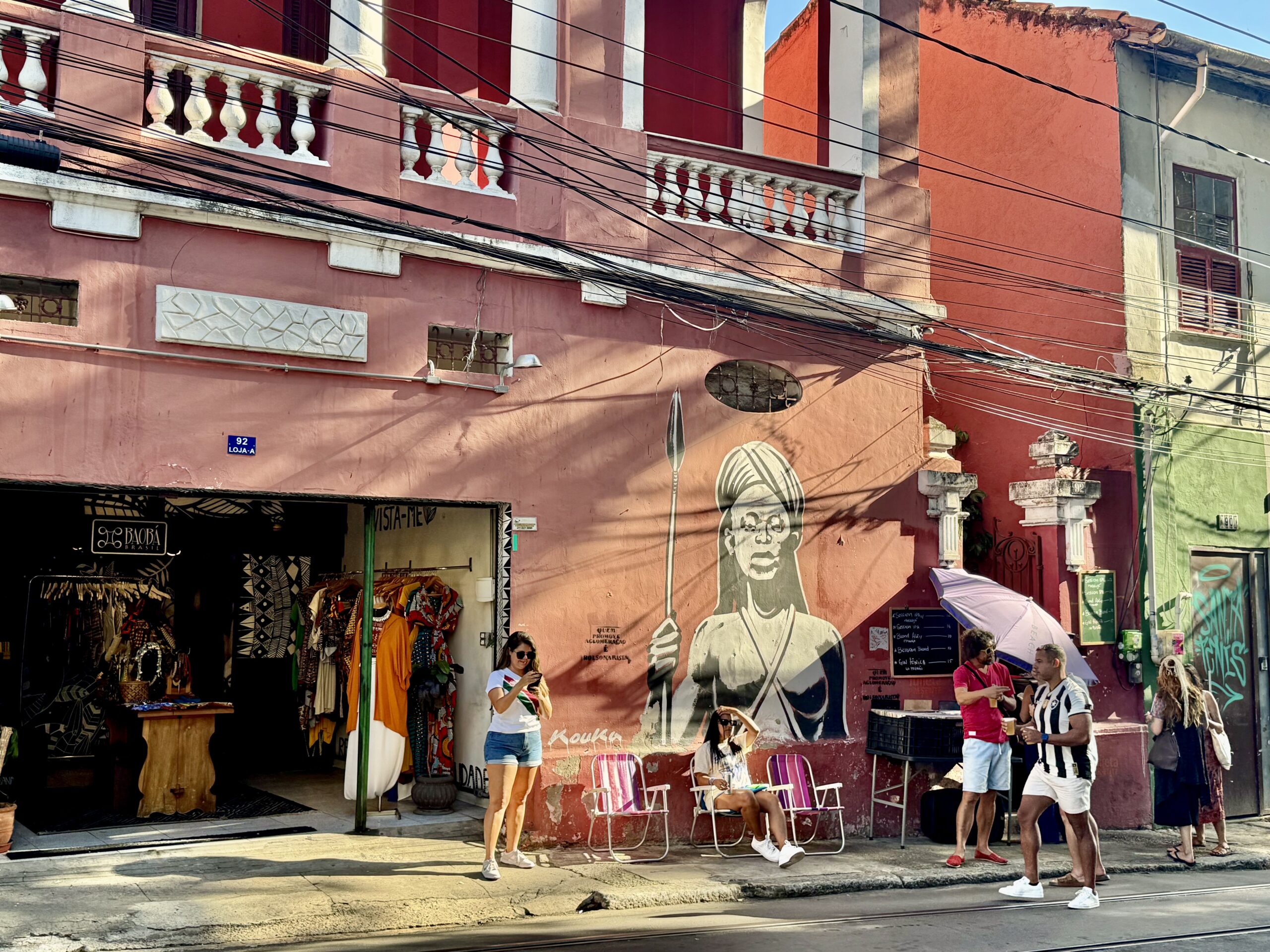
We zitten op een scheef stoepje voor Café Mo, tussen mintgroene tegels en roze kozijnen, koffie in de hand en capucijnaapjes boven ons hoofd. Ze schreeuwen harder dan het brommerverkeer en rennen over de telefoonkabels alsof de stad en ons cappuccino-moment niet bestaan. Binnen zien we prints, keramiek en espresso. Buiten: de chaos van Rio, verpakt in kleurrijke muurschilderingen.
Van villawijk naar artistieke hotspot
Santa Teresa begint als elitewijk met uitzicht, eind negentiende eeuw verrijzen hier villa’s met veranda’s en een blik op de baai. In de decennia daarna vertrekken veel families en komen kunstenaars, muzikanten en creatievelingen ervoor in de plaats. Ze herstellen gevels, openen galerieën en schilderen de wijk in nieuwe tinten. Santa Teresa krijgt een ander ritme, speelser en vrijer, met kunst op de muren en muziek in de lucht die er nog altijd hangt.
Wandelend door de smalle, kronkelige straatjes lijkt elke hoek te verrassen: een gevel bedekt met mozaïek, een onverwacht doorkijkje over de stad, een gids die met grote gebaren een groep toeristen over het leven in Rio vertelt. Geen perfect plaatje, maar wel een dat leeft, en we lopen als vanzelf wat langzamer.
Een park vernoemd naar een pionier
Een korte klim brengt ons bij Parque Glória Maria. In een open ruïne hangen plastic jurken aan lijnen, kunst gemaakt van gerecycled materiaal, en op de muur staat een gigantisch portret geschilderd door street artist Eduardo Kobra: een wereldbol in haar hand, vlinders om haar hoofd. Glória Maria was de eerste zwarte vrouw op de Braziliaanse televisie, ze reisde de wereld rond voor TV Globo en interviewde beroemdheden als Madonna, altijd met die onafhankelijke blik die haar bekend maakte. Sinds 2023 draagt het park haar naam.
“Op de muur: een gigantisch portret, wereldbol in haar hand, vlinders om haar hoofd.”
Boven op de ruïne hangt stilte, alleen uitzicht en een pauze in de stad. Even helemaal niks, terwijl beneden alles doorraast.
Wat niet meteen opvalt
En dan weer naar beneden, want daar bruist het pas echt. Straatverkopers hangen doeken over hekken, koffiebars als Alto en Armazém zitten vol, en in kleine galeries hangt werk van buurtkunstenaars. Op het plein klinkt gitaarspel, kinderen rennen tussen de stoelen door, toeristen kijken toe met een verse suco in de hand. Bij São Joachim schuiven we aan voor rijst, bonen en vis, en met een beetje geluk schuift de eigenaar zelf ook nog even bij ons aan.
Alles voelt licht, kleurrijk en druk, tot we even blijven hangen en merken dat er ook wat schuurt. Niet alles is mozaïek en muziek: sommige ateliers zijn dicht, er hangt een menukaart in het Engels en plotseling betalen we het dubbele voor een sapje. De wijk leeft, maar verandert, en niet iedereen loopt mee in dat tempo.
Wie met het trammetje omhoog gaat, loopt vaak te voet weer terug, niet uit romantiek maar omdat het simpelweg makkelijker is dan wachten. Onderweg scoren we een flirt, een straatijsje en een print waar we thuis eigenlijk geen plek voor hebben. Op een muur lezen we dan: “Tudo passa.” Alles gaat voorbij. Santa Teresa doet net alsof ze het nog niet gehoord heeft, en buigt intussen alweer om de volgende hoek.
We sit on a crooked step outside Café Mo, between mint green tiles and pink window frames, coffee in hand, capuchin monkeys overhead. They scream louder than the passing scooters and race across the telephone wires as if the city, and our cappuccino moment, simply do not exist. Inside: prints, ceramics, espresso. Outside: the chaos of Rio, wrapped in colorful murals.
From hillside villas to artistic hideout
Santa Teresa began as an elite neighborhood with a view, its villas rising in the late nineteenth century with verandas overlooking the bay. In the decades that followed, many families moved out and artists, musicians and other creative types moved in. They restored facades, opened galleries and repainted the neighborhood in new shades. Santa Teresa picked up a different rhythm, looser and more playful, with art on the walls and music in the air that still lingers today.
Walking the narrow, winding streets, every corner seems to hold a surprise: a facade covered in mosaic tile, an unexpected gap between buildings opening onto the skyline, a guide gesturing wildly while telling a group of tourists about life in Rio. It is not a polished picture, but it is alive, and we find ourselves slowing down without meaning to.
A park named for a pioneer
A short climb brings us to Parque Glória Maria. Inside an open ruin, plastic dresses hang from lines, art made from recycled material, and on the wall looms a massive portrait painted by street artist Eduardo Kobra: a globe in her hand, butterflies circling her head. Glória Maria was the first Black woman on Brazilian television, she traveled the world for TV Globo and interviewed celebrities like Madonna, always carrying that independent gaze she became known for. Since 2023 the park has carried her name.
“On the wall: a massive portrait, a globe in her hand, butterflies circling her head.”
At the top of the ruin, silence takes over, just a view and a pause from the city. A moment of nothing at all, while everything below keeps rushing forward.
What does not show right away
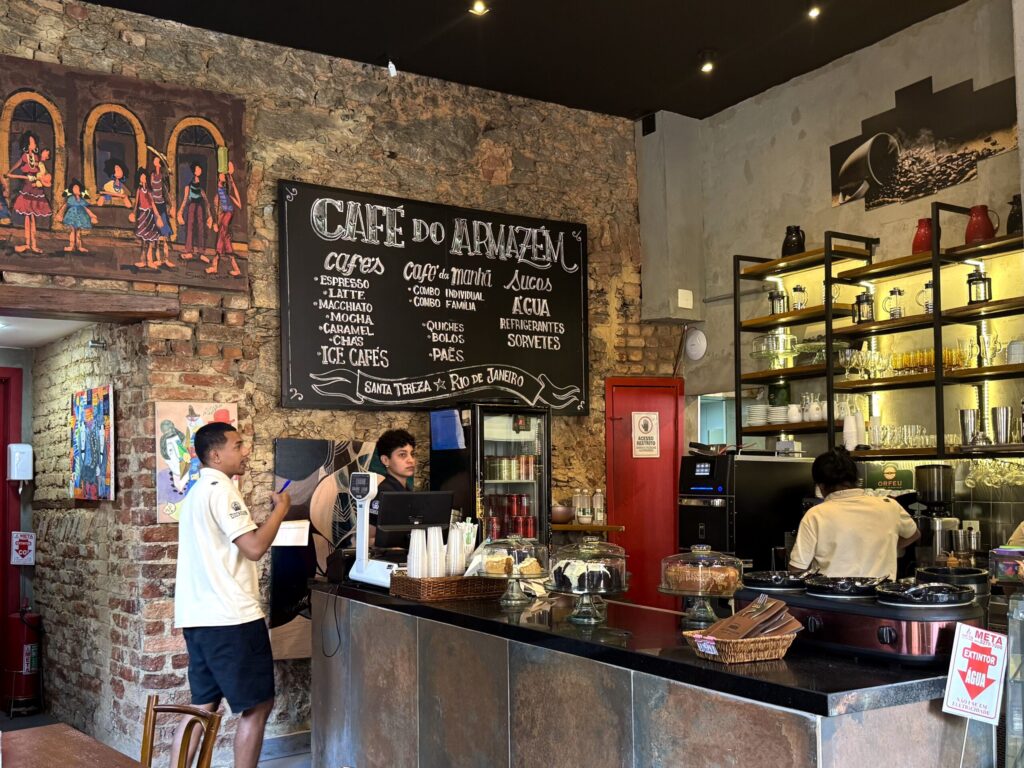
Then back down, because that is where things really hum. Street vendors drape cloth over railings, coffee spots like Alto and Armazém fill up, and small galleries display work from neighborhood artists. Guitar music drifts across the square, kids run between chairs, tourists watch with fresh suco in hand. At São Joachim we line up for rice, beans and fish, and if we are lucky the owner himself pulls up a chair beside us.
Everything feels light, colorful and alive, until we linger a little longer and notice something underneath it all. Not everything here is mosaic and music: some studios sit shuttered, a menu suddenly appears in English, and a juice costs double what it did yesterday. The neighborhood is alive, but it is changing, and not everyone moves at the same pace.
Those who ride the tram up often walk back down on foot, not out of romance but because it is simply easier than waiting. Along the way we pick up a flirtation, a street popsicle and a print we have no wall for back home. On one wall we read: “Tudo passa.” Everything passes. Santa Teresa acts as if it has not heard yet, already curving around the next corner.
Santa Teresa bezoeken, dit moet je weten
Santa Teresa ligt op een heuvel boven het centrum van Rio, tussen Lapa en Glória. De historische geelblauwe bonde (tram) rijdt vanaf station Carioca in het centrum via de Arcos da Lapa omhoog naar de wijk. Doordeweeks vertrekken trams van 8.00 tot 18.30 uur, in het weekend en op feestdagen van 9.00 tot 17.00 uur. Het ritje kost 20 real (ongeveer 3 euro) en trams gaan elk uur, met een capaciteit van 32 personen; tijdens drukke dagen kan de verkoop al voor 16.00 uur stoppen. Parque Glória Maria is dagelijks vrij toegankelijk en gratis.
Wandel de wijk het beste in de ochtend of laat in de middag als de zon minder scherp is. Cafés zoals Café Mo, restaurant Aprazível en het Museu Chácara do Céu (dinsdag tot en met zondag 12.00-17.00 uur, 8 real entree) zijn de moeite waard. Overdag is Santa Teresa veilig voor toeristen, maar wees na zonsondergang alert op zakkenrollers en neem liever een Uber terug. Laat waardevolle spullen in het hotel en draag geen zichtbare sieraden. De wijk loopt sterk op en af, dus goede loopschoenen zijn belangrijk.
Vaakgestelde vragen over Santa Teresa
Hoe kom ik in Santa Teresa?
Met de historische bonde vanaf station Carioca, of met de Uber vanuit Copacabana (20-30 minuten, rond 25 real). Ook zes minuten lopen omhoog vanaf Lapa als je conditie hebt.
Wat kost een tramrit?
20 real (ongeveer 3 euro) per rit. Doordeweeks 8.00 tot 18.30 uur, weekend en feestdagen 9.00 tot 17.00 uur. Bij drukte kan de verkoop rond 16.00 uur al sluiten.
Is Santa Teresa veilig?
Overdag ja, met normale grootstadsvoorzichtigheid. Na zonsondergang alerter zijn: neem een Uber, houd waardevolle spullen uit het zicht, draag geen sieraden.
Wat is Parque Glória Maria?
Een open ruïnepark met kunst van gerecycled materiaal en een groot muurportret van Glória Maria door Eduardo Kobra. Gratis toegang, sinds 2023 vernoemd naar de eerste zwarte vrouw op de Braziliaanse televisie.
Wat is de beste tijd om te gaan?
April tot en met oktober (Zuid-Amerikaanse herfst en winter). Temperaturen 20-28 graden, minder vochtig. Vermijd januari en februari wegens hitte en drukte rond Carnaval.
Hoe lang moet ik uittrekken?
Een halve dag voor de highlights: tramrit, wandeling door de straten, koffie bij Café Mo, Museu Chácara do Céu. Combineer eventueel met Lapa (Arcos, Escadaria Selarón) voor een hele dag.
Over Elle
Elle Verbeek is reisjournalist en purser bij KLM. Ze schrijft columns en reisverhalen, deels voor eigen platform, deels voor Nederlandse magazines. Op Ellevie Travels deelt ze reisreportages van de bestemmingen waar ze naartoe vliegt of waar ze zelf naartoe reist.
Meer uit Rio de Janeiro
Visiting Santa Teresa: what to know
Santa Teresa sits on a hill above central Rio, between Lapa and Glória. The historic yellow-and-blue bonde (tram) runs from Carioca station in the center over the Arcos da Lapa up into the neighborhood. Weekdays trams depart from 8:00 AM to 6:30 PM, weekends and holidays from 9:00 AM to 5:00 PM. A ride costs 20 reais (about 3 euros) and trams run hourly, with a capacity of 32 people; sales can close before 4:00 PM on busy days. Parque Glória Maria is freely accessible every day.
Explore the neighborhood in the morning or late afternoon when the sun is less harsh. Cafés like Café Mo, restaurant Aprazível, and Museu Chácara do Céu (Tuesday through Sunday 12:00-5:00 PM, 8 reais admission) are worth your time. During the day Santa Teresa is safe for tourists, but stay alert for pickpockets after sunset and take an Uber back. Leave valuables at the hotel and don’t wear visible jewelry. The neighborhood is very hilly, so good walking shoes matter.
Frequently asked questions about Santa Teresa
How do I get to Santa Teresa?
By the historic bonde from Carioca station, or by Uber from Copacabana (20-30 minutes, about 25 reais). Also a six-minute walk uphill from Lapa if you’re fit.
What does a tram ride cost?
20 reais (about 3 euros) per ride. Weekdays 8:00 AM to 6:30 PM, weekends and holidays 9:00 AM to 5:00 PM. Sales can close around 4:00 PM on busy days.
Is Santa Teresa safe?
During the day yes, with normal big-city awareness. After sunset be more alert: take an Uber, keep valuables out of sight, don’t wear jewelry.
What is Parque Glória Maria?
An open ruin-park with art from recycled materials and a large mural portrait of Glória Maria by Eduardo Kobra. Free access. Renamed in 2023 after the first Black woman on Brazilian television.
What is the best time to visit?
April through October (South American autumn and winter). Temperatures 20-28 Celsius, less humid. Avoid January and February for heat and Carnaval crowds.
How much time do I need?
Half a day for the highlights: tram ride, wander the streets, coffee at Café Mo, Museu Chácara do Céu. Combine with Lapa (Arcos, Escadaria Selarón) for a full day.
About Elle
Elle Verbeek is a travel journalist and KLM purser. She writes columns and travel stories, partly for her own platform, partly for Dutch magazines. On Ellevie Travels she shares reportage from the destinations she flies to or travels to on her own.
More from Rio de Janeiro
Praktische tips uit dit verhaal Practical tips from this story
-
Cultureel centrum / uitzichtpunt Parque Glória Maria (v/h Parque das Ruínas) — Open ruïne met plastic jurken als kunst en een gigantisch Kobra-portret van tv-icoon Glória Maria. Bovenop: stilte, uitzicht, een pauze in de stad.
Cultural centre / viewpoint Parque Glória Maria (formerly Parque das Ruínas) — Open ruin hung with plastic-dress art and Kobra's mural of TV pioneer Glória Maria. On top: silence, view, a pause from the city.
-
Lokaal buurtrestaurant São Joachim — Aanschuiven voor rijst, bonen en vis. De salade met gefrituurde krab: gewoon doen. Met een beetje geluk schuift de kok zelf ook nog aan.
Local neighbourhood restaurant São Joachim — Join the queue for rice, beans and fish. Get the fried-crab salad. If you're lucky, the cook joins your table too.
-
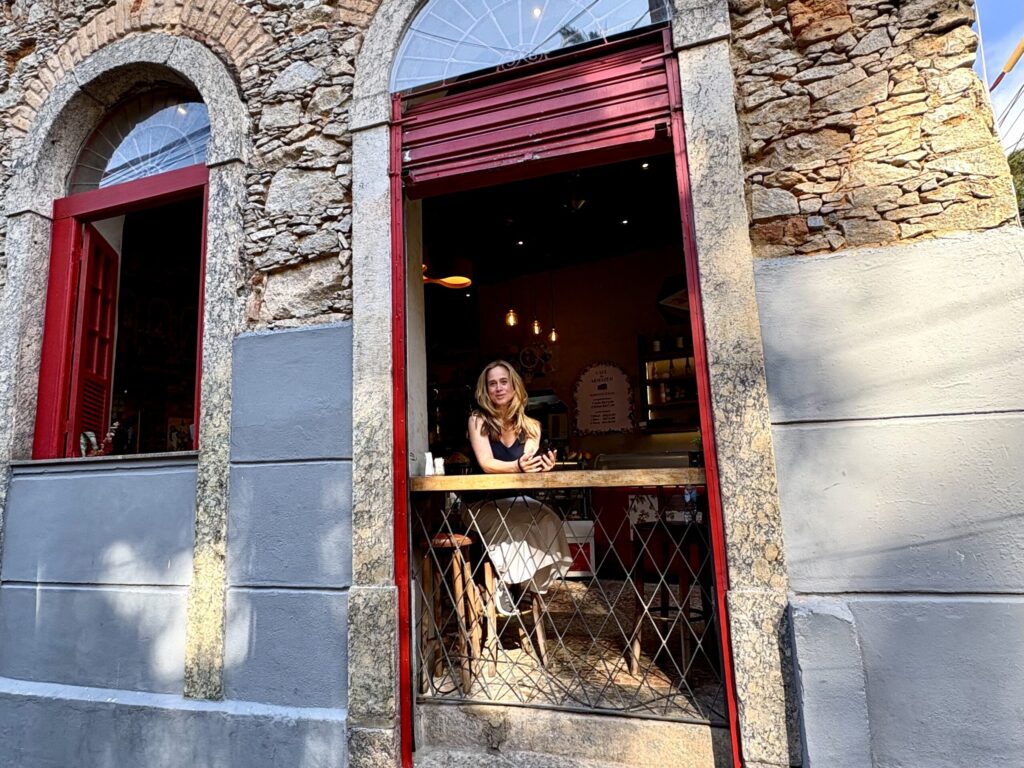
Café / conceptstore Café Mo — Scheef stoepje, mintgroene tegels, roze kozijnen. Binnen: prints, keramiek en espresso. Buiten: brommerchaos en apen op de telefoonkabels. @cafemo.rio
Café / concept store Café Mo — Slanting sidewalk, mint-green tiles, pink window frames. Inside: prints, ceramics and espresso. Outside: scooter chaos and capuchin monkeys on the phone lines. @cafemo.rio
-
Openbaar park + landhuis / kunstacademie Parque Lage — Neorenaissance landhuis aan de voet van de Corcovado met wandelpaden door regenwoud en dé Instagramspot van Rio. Kom vroeg voor rust, sla de zalmsalade op het terras over. eavparquelage.rj.gov.br · @parquelageoficial · meer info
Public park + mansion / art school Parque Lage — Neo-renaissance mansion at the foot of Corcovado, with rainforest trails and Rio's most-Instagrammed courtyard. Arrive early for calm, skip the salmon salad at the café. eavparquelage.rj.gov.br · @parquelageoficial · more info
-
Strand Copacabana strand — Vier kilometer strand, met loopbrug in het karakteristieke Portugese golfmotief. Vroeg 's ochtends rennen locals hier, 's middags speelt de volledige stad op het zand.
Beach Copacabana beach — Four kilometers of beach, with a boardwalk in the iconic Portuguese wave pattern. Early morning locals run here, in the afternoon the entire city plays on the sand.
-
Buurtcafés Alto & Armazém — Twee cafés binnen een straat: Armazém knus en rustig, Alto levendig met live gitaar en toeristen met verse suco.
Neighbourhood cafés Alto & Armazém — Two cafés within a single street: Armazém cosy and calm, Alto lively with live guitar and travellers holding fresh sucos.