
De geur van gebrande bonen hangt in de smalle trap die naar boven kronkelt. Boven een wijnwinkel, ergens in Palermo, staat een jongen op de tweede verdieping koffie te branden. Dit is Kissaten Tostador, en dit is waar we in Buenos Aires koffie gaan drinken. Buenos Aires heeft honderden cafés, maar deze drie plekken vertellen drie verschillende verhalen van de stad: een piepklein en verstopt, een herboren icoon en een waar de schrijver Borges nog steeds over onze schouder mee lijkt te kijken.
Kissaten Tostador, verstopt boven een wijnwinkel
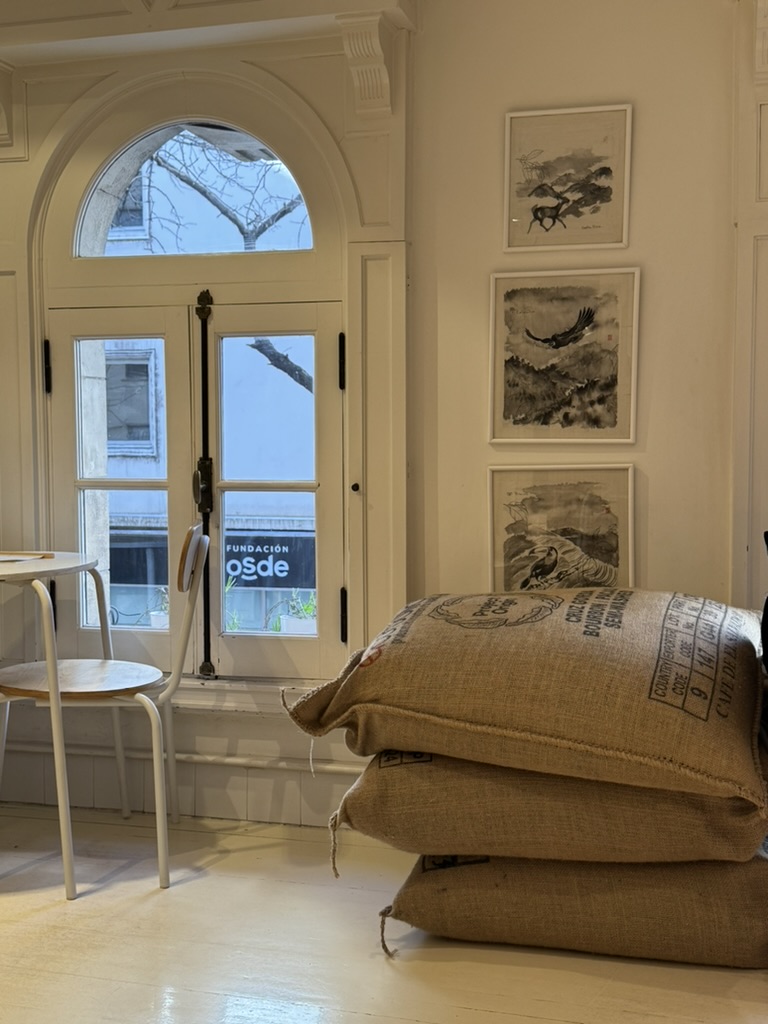
We moeten het weten, anders vinden we het nooit. Boven een wijnwinkel in Palermo zit deze koffiezaak die nauwelijks groter is dan een woonkamer: een paar tafels, houten krukken, een glimmende espressomachine en de geur van versgebrande bonen. De eigenaar, een jonge barista die ooit in Tokio werkte, brandt zijn bonen zelf, bijna meditatief. De espresso smaakt naar cacao en sinaasappelschil, de flat white wordt geserveerd in een zware aardewerken kom.
Het voelt alsof we Buenos Aires even op pauze zetten, dezelfde intensiteit maar in fluistertoon. En dan dalen we de trap weer af, de chaos in. Alsof we even buiten de stad zijn geweest, midden in de stad.
El Ideal, een icoon dat terugkeerde
In het hart van Microcentro, op de hoek van Suipacha en Corrientes, ligt Café El Ideal. Decennialang was dit het trefpunt van tangodansers, schrijvers en bureaucraten, tot het sloot en langzaam uit het stadsbeeld verdween. Na een zorgvuldige restauratie is alles weer zoals het was, en beter. De marmeren vloeren glanzen, de spiegels schitteren, de obers dragen zwarte vesten alsof de tijd nooit is voorbijgegaan.
Aan de tafels zitten toeristen met camera’s, maar ook oude mannen die hun krant openslaan alsof het nog 1952 is. Onze cortado komt met een glaasje bruiswater en de medialunas, croissants met een suikerlaagje erover, zijn boterzacht.
“Hier valt geschiedenis samen met het dagelijkse leven, kopje voor kopje.”
La Biela, tegenover Evita’s rustplaats
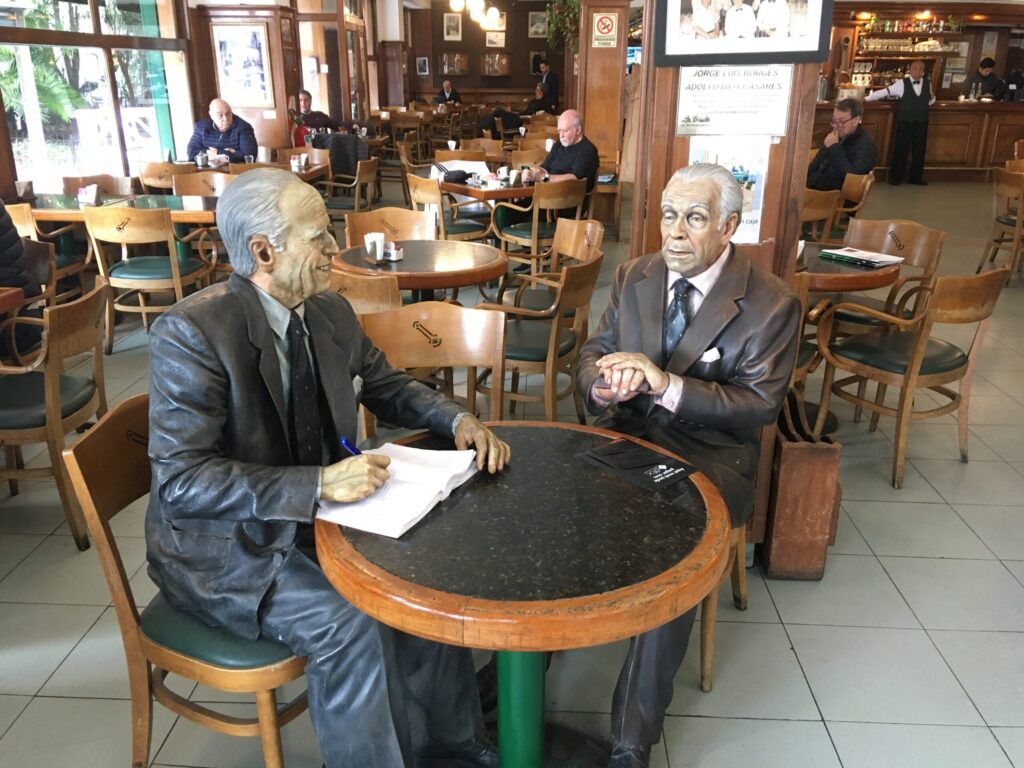
Een kwartier verder, in Recoleta, zit La Biela, tegenover de beroemde begraafplaats waar Evita Perón rust, onder een reusachtige gomboom. Hier drinkt de stad haar koffie zoals ze dat altijd heeft gedaan, zonder haast. Binnen hangen zwart witfoto’s van coureurs, schrijvers en politici, en aan de muur een portret van Borges, die hier zijn cortado dronk met zijn vriend Adolfo Bioy Casares.
De koffie is prima, niet heilig. Maar het gaat om de sfeer: het geroezemoes, het geluid van lepeltjes in kopjes, de gesprekken die nergens en overal over gaan. Buiten ritselen de bomen en toeristen maken foto’s, en we denken: dit klassieke caféleven kan hier niet verdwijnen.
Drie smaken van een en dezelfde stad
Drie cafés, drie karakters. Bij Kissaten Tostador proeven we het nieuwe: precies, minimalistisch, werelds. In El Ideal herleeft de oude glorie, opgepoetst maar met de ziel intact. En La Biela is als de tijd zelf: onverstoorbaar, rommelig en vol verhalen.
Koffie drinken in Buenos Aires is een ritueel, ’s ochtends een espresso, ’s middags een cortado, later misschien een café con leche met medialunas erbij. Er wordt gepraat, gediscussieerd en geroddeld. Koffie is hier nooit zomaar koffie.
Tussen Palermo Soho en Recoleta laten we de bezienswaardigheden soms even links liggen en volgen we gewoon de geur. Buiten, op straat, stapt een ober met een dienblad vol lege kopjes de zaak weer binnen, en de deur valt met een zacht geklingel achter hem dicht.
The smell of roasting beans hangs in the narrow staircase winding upward. Above a wine shop, somewhere in Palermo, a young man roasts coffee on the second floor. This is Kissaten Tostador, and this is where we go to drink coffee in Buenos Aires. The city has hundreds of cafes, but these three places tell three different stories of the city: one tiny and hidden, one a reborn icon, and one where writer Jorge Luis Borges still seems to look over our shoulder.
Kissaten Tostador, tucked above a wine shop
We have to know it is there, or we will never find it. Above a wine shop in Palermo sits this coffee spot, barely bigger than a living room: a few tables, wooden stools, a gleaming espresso machine and the smell of freshly roasted beans. The owner, a young barista who once worked in Tokyo, roasts his own beans, almost meditatively. The espresso tastes of cacao and orange peel, the flat white arrives in a heavy earthenware bowl.
It feels like pressing pause on Buenos Aires for a moment, the same intensity but in a whisper. Then we head back down the stairs, into the chaos. As if we had briefly stepped outside the city while standing right in the middle of it.
El Ideal, an icon that came back
In the heart of Microcentro, on the corner of Suipacha and Corrientes, sits Cafe El Ideal. For decades this was the meeting point for tango dancers, writers and bureaucrats, until it closed and slowly faded from the city’s memory. After a careful restoration, everything looks the way it did, only better. The marble floors gleam, the mirrors shine, the waiters wear black vests as if time never passed.
Tourists with cameras sit at the tables, but so do old men unfolding their newspapers as if it were still 1952. Our cortado arrives with a small glass of sparkling water, and the medialunas, croissants dusted with a thin sugar glaze, are butter soft.
“Here, history and daily life meet, one cup at a time.”
La Biela, across from Evita’s resting place
A quarter hour away, in Recoleta, sits La Biela, across from the famous cemetery where Evita Peron rests, beneath an enormous rubber tree. Here the city drinks its coffee the way it always has, without hurry. Inside hang black and white photos of race car drivers, writers and politicians, and on the wall a portrait of Borges, who used to drink his cortado here with his friend Adolfo Bioy Casares.
The coffee is fine, not sacred. What matters is the atmosphere: the murmur of conversation, the clink of spoons against cups, talk that drifts from nowhere to everywhere. Outside the trees rustle and tourists take photos, and we think this kind of classic cafe life simply cannot disappear from here.
Three flavors of the same city
Three cafes, three characters. At Kissaten Tostador we taste the new: precise, minimal, worldly. At El Ideal the old glory lives again, polished but with its soul intact. And La Biela is like time itself: unshaken, a little messy and full of stories.
Drinking coffee in Buenos Aires is a ritual, an espresso in the morning, a cortado in the afternoon, maybe a cafe con leche with medialunas later. People talk, argue and gossip. Coffee here is never just coffee.
Walking between Palermo Soho and Recoleta, we skip the sights for a moment and simply follow the smell instead. Outside, on the street, a waiter carrying a tray of empty cups steps back inside, and the door clicks softly shut behind him.
Specialty coffee in Buenos Aires bezoeken, dit moet je weten
De specialty scene in Buenos Aires draait om Palermo, met een dichte concentratie in Palermo Hollywood en Palermo Soho. LAB Tostadores de Café op Humboldt 1542 is pionier sinds 2013 en verzorgt de eigen branding in het atelier boven de bar. Rita Specialty Coffee heeft meerdere adressen; het startlokaal aan Armenia 1595 en de vestiging op Soler 6093 zitten aan brede stoepen waar we buiten kunnen zitten.
De meeste specialty bars openen tussen acht en negen ’s ochtends en sluiten rond zeven ’s avonds. Verwacht een filter- of espressoprijs die vergelijkbaar is met Europa: drie tot vijf euro voor een cortado, vier tot zes voor een filter. Wifi is doorgaans goed, tafels beperkt in het weekend; wie er een half uur wil blijven werken, komt beter door de week.
Wat we aanraden voor een middag: begin bij LAB in Palermo Hollywood voor een filter, wandel naar Rita voor een cortado met een medialuna; sluit af in Belgrano bij The Coffee Store voor een flat white. Zo proeven we drie verschillende porteño-registers binnen een halve dag.
Vaakgestelde vragen over koffie in Buenos Aires
Waar drinken we de beste espresso?
LAB Tostadores in Palermo Hollywood staat internationaal in de top van World’s Best Coffee Shops. Voor een meer klassieke Argentijnse cortado zijn Café Martínez en Bonafide de traditionele adressen; die vinden we door de hele stad.
Doen de meeste bars filtercoffee?
Ja, alle drie de plekken uit dit verhaal hebben pour-over of AeroPress op de kaart. Voor bewuste filterprogramma’s raden we LAB en Rita aan; die serveren single origins met smaakkaartjes.
Wat kost een specialty koffie?
Reken op tweeduizend tot drieduizend Argentijnse peso voor een cortado of flat white; tweeënhalf- tot vierduizend voor een filter. Prijzen fluctueren met de inflatie; controleer de kaart bij het bestellen.
Zit er wifi in de bars?
Bijna overal. Palermo-adressen kennen expat- en digital-nomad-publiek en de wifi is meestal stabiel. In het weekend zijn de tafels vol; kom voor twaalf uur als je wilt werken.
Wat is medialuna?
De Argentijnse variant van een croissant, zoeter en compacter dan de Franse. Elke koffiebar verkoopt ze bij de kassa; dulce de leche is een klassieke combinatie.
Kunnen we koffiebonen mee naar huis nemen?
Ja, LAB en Rita verpakken beans op verzoek. Neem het originele label mee door de douane en verklaar het bij aankomst als je meer dan een kilo meeneemt.
Over Elle
Elle Verbeek is reisjournalist en purser bij KLM. Ze schrijft columns en reisverhalen, deels voor eigen platform, deels voor Nederlandse magazines. Op Ellevie Travels deelt ze reisreportages van de bestemmingen waar ze naartoe vliegt of waar ze zelf naartoe reist.
Meer uit Buenos Aires
Visiting specialty coffee in Buenos Aires: what to know
The specialty scene in Buenos Aires centers on Palermo, with the densest cluster in Palermo Hollywood and Palermo Soho. LAB Tostadores de Café at Humboldt 1542 has been a pioneer since 2013 and roasts in the workshop above the bar. Rita Specialty Coffee has multiple locations; the original at Armenia 1595 and the Soler 6093 branch sit on wide sidewalks made for outdoor tables.
Most specialty bars open between eight and nine in the morning and close around seven in the evening. Expect European-style prices: three to five euros for a cortado, four to six for a filter. Wi-Fi is generally strong, tables scarce on weekends; if we plan to work for half an hour, weekdays are calmer.
Our afternoon route: start at LAB in Palermo Hollywood for a filter, walk to Rita for a cortado and medialuna, and finish at The Coffee Store in Belgrano for a flat white. Three different porteño registers in half a day.
Frequently asked questions about coffee in Buenos Aires
Where do we drink the best espresso?
LAB Tostadores in Palermo Hollywood ranks among the World’s Best Coffee Shops. For a more classic Argentine cortado, Café Martínez and Bonafide are the traditional addresses, spread across the city.
Do most bars serve filter coffee?
Yes, all three cafés in this piece offer pour-over or AeroPress. For dedicated filter programs we recommend LAB and Rita, both of which serve single origins with tasting notes.
How much does specialty coffee cost?
Expect 2,000 to 3,000 Argentine pesos for a cortado or flat white, and 2,500 to 4,000 for a filter. Prices shift with inflation, so check the menu when ordering.
Is there Wi-Fi in the bars?
Nearly everywhere. Palermo addresses attract expats and digital nomads, and the Wi-Fi is usually stable. Weekend tables fill fast; arrive before noon if you want to work.
What is a medialuna?
The Argentine version of a croissant — sweeter and more compact than the French one. Every coffee bar sells them at the counter; dulce de leche is the classic pairing.
Can we take beans home?
Yes, LAB and Rita will pack beans on request. Keep the original label for customs, and declare on arrival if you’re bringing more than a kilo.
About Elle
Elle Verbeek is a travel journalist and KLM purser. She writes columns and travel stories, partly for her own platform, partly for Dutch magazines. On Ellevie Travels she shares reportage from the destinations she flies to or travels to on her own.
More from Buenos Aires
Praktische tips uit dit verhaal Practical tips from this story
-
Kusttrein · panoramische route Tren de la Costa — Route slingert langs parken, villa's en kleine strandjes. Cadeautje van een plan B als je de ferry naar Buenos Aires mist. Stap uit in Acassuso voor een vogelpark en ver uitzicht over de Río de la Plata. trendelacosta.com.ar · meer info
Coastal train · scenic route Tren de la Costa — The route winds past parks, villas and small beaches. A gift of a plan B if you miss the ferry back to Buenos Aires. Get off in Acassuso for a bird park and long views across the Río de la Plata. trendelacosta.com.ar · more info
-
Restaurant · vegetarisch · Villa Crespo Chuí — plantaardig fine dining in een groene loods — Een oude loods vol planten en filtered daglicht, waar groente de hoofdrol krijgt. Gerechten met chimichurri, geroosterde bloemkool en champignonpaté, zonder dat je vlees mist. chui.com.ar · meer info
Restaurant · vegetarian · Villa Crespo Chuí — plant-based fine dining in a green warehouse — An old warehouse full of plants and filtered daylight, where vegetables take centre stage. Dishes with chimichurri, roasted cauliflower and mushroom pâté that leave no room for missing meat. chui.com.ar · more info
-
Klassiek koffiehuis · notabel café La Biela — Zwart-witfoto's van coureurs, schrijvers en politici aan de muur; een portret van Borges, die hier zijn cortado dronk met Adolfo Bioy Casares. De koffie is oké, niet heilig — het gaat om het geroezemoes, het klinken van lepeltjes en het schaduwrijke terras onder de gomboom. labiela.com · @labielarecoleta · meer info
Classic coffee house · café notable La Biela — Black-and-white photos of racing drivers, writers and politicians on the walls; a portrait of Borges, who drank his cortado here with Adolfo Bioy Casares. The coffee is fine, not sacred — it's about the hum, the tinkling of spoons and the shady terrace under the rubber tree. labiela.com · @labielarecoleta · more info
-
Milonga / dansclub La Catedral Club — Grote loods, hoge plafonds, gerecycled meubilair en tango zonder dresscode. Beginnersles vooraf; daarna aanschuiven of van een afstand kijken. @lacatedralclub
Milonga / dance club La Catedral Club — Cavernous warehouse, high ceilings, mismatched furniture and tango without a dress code. Beginner's class first, then dance or watch from the sidelines. @lacatedralclub
-
Traditionele milonga Salón Canning — Klassieke tempo, kleine ronde tafels rondom de dansvloer, respect voor de codes. Kom mooi aangekleed en kijk goed naar de cabeceo. @saloncanning
Traditional milonga Salón Canning — Classic tempo, small round tables around the floor, all the traditional codes. Dress nicely and watch the cabeceo carefully. @saloncanning
-
Milonga · tango · Almagro La Marshall — de queer milonga van Buenos Aires — Rollen wisselen, iedereen is welkom. Start om 21.00 uur met dansles, daarna gaat de milonga door tot laat. hoy-milonga.com · meer info
Milonga · tango · Almagro La Marshall — Buenos Aires' queer milonga — Roles switch freely, everyone is welcome. Starts at 9 PM with a dance lesson, then the milonga continues late into the night. hoy-milonga.com · more info